
If you want to speak French out loud from your first week, Praktika is the best app to learn French for most learners in 2026. It gives you spoken French conversations with human-like AI tutors, instant corrections on pronunciation, grammar and word choice, and a personal study plan that adapts to your goal and pace.
Praktika suits beginners with a real deadline, like a professional whose company is transferring them to Montreal next year and who mostly has a commute to practice. It also fits people relocating to France, travelers with a trip to Paris booked, and learners who studied French at school and still freeze when someone answers at full speed.
The other nine apps on this list take different routes into French. You'll find gamified daily lessons, grammar-led courses, community corrections, picture-based immersion, speaking drills, audio lessons for the car, native-speaker videos, a wide multi-language catalog and private human teachers, with a clear note on who each one suits.
This comparison is based on factual App Store and Google Play reviews and a detailed analysis of each app in November 2026.
Best App to Learn French: Top 10 at a Glance
This table compares the best apps for learning French side by side. Use it to shortlist two or three that match your goal, then read the detailed reviews below.
| Tool | Best For | Key Features | Pros | Cons |
|---|---|---|---|---|
| Praktika | Speaking French with confidence | AI tutors with memory, real-time corrections, native-language explanations, adjustable speaking speed | Open spoken French from day one; tutors remember your mistakes | No certificates or exam pathway; mobile apps only for now |
| Duolingo | A daily French habit | Bite-sized lessons, streaks and leagues, 40+ languages | Free core course; highly motivating | Little grammar explanation; short speaking exercises |
| Babbel | French grammar foundations | Expert-built lessons, real-life dialogues, podcasts, spaced review | Clear explanations; lessons tailored to your native language | Speech recognition complaints; limited open conversation |
| Busuu | Native-speaker feedback on French | Community corrections, study plan, cultural notes, real-speaker videos | Human corrections; strong grammar context | Ads in the free version; feedback isn't instant |
| Rosetta Stone | Picture-based French immersion | No-translation lessons, pronunciation checks, offline mode | Full immersion; calm, ad-free lessons | No grammar explanations; Classic app limited to existing subscribers |
| Speak | Guided French speaking drills | Speaking-first lessons, AI roleplays, instant feedback | Most of each lesson spent talking | Seven languages only; uneven speech recognition |
| Pimsleur | Hands-free French on a commute | 30-minute audio lessons, Pronunciation Challenge, AI Conversation Coach (Beta) for French | Strong listening and pronunciation focus | Fixed pacing; few visuals |
| Memrise | French listening and vocabulary | Native-speaker videos, goal tracks, AI conversation practice | Real accents; goal-based vocabulary | Paywalled grammar; redesign complaints |
| Mondly | French among many languages | 41 languages, human-like chatbot, hands-free mode | Short, well-organized lessons; wide range | Speech recognition issues; thin grammar |
| italki | Private French teachers | 1-on-1 video lessons, flexible booking, lesson summaries | Native teachers, including teachers from Quebec | Lessons need scheduling; costs add up for daily practice |
If your goal is to talk with coworkers and neighbors in French, start with Praktika, then add Pimsleur for the car or italki for an occasional human lesson. Duolingo and Babbel remain the classic picks for vocabulary and grammar alongside a speaking app.
Why Learn French With an App?
French is an official language in Canada, France, Belgium, Switzerland and much of West and Central Africa. For a beginner with a move or a trip coming up, an app turns a train ride, a walk to the office or a coffee break into French practice.
The catch is that written French and spoken French can feel far apart. Spelling hides pronunciation, and native speakers link and drop sounds in everyday speech, so you need to hear and say French often before it clicks.
What French Apps Do Well
A good French app makes daily practice easy to start and hard to skip. Ten minutes on a commute, five days a week, adds up to more speaking and listening than a weekly evening class you keep moving.
Apps also cover the groundwork beginners need early, such as greetings, numbers, gendered nouns and core verbs like être, avoir and aller. They bring new words back at the right moment, so vocabulary sticks between sessions.
The best French learning apps now add speech recognition and AI conversation too. You can hear yourself in French long before you'd raise your hand in a classroom.
Where Most French Apps Fall Short
Many French apps train you to recognize the language, and conversation asks you to produce it. Matching pairs and tapping tiles builds a reading vocabulary, while a real exchange in Montreal or Lyon needs full sentences, out loud, at speed.
French makes that gap wider. Nasal vowels, the French r, the choice between tu and vous and liaison between words all take repeated speaking practice with feedback, and short speech exercises rarely give enough of it.
Accent is the other gap. Most apps to learn French teach the French of France, so learners moving to Quebec often meet a different accent and everyday words such as dépanneur for a corner store or fin de semaine for the weekend.
Best App to Learn French Overall
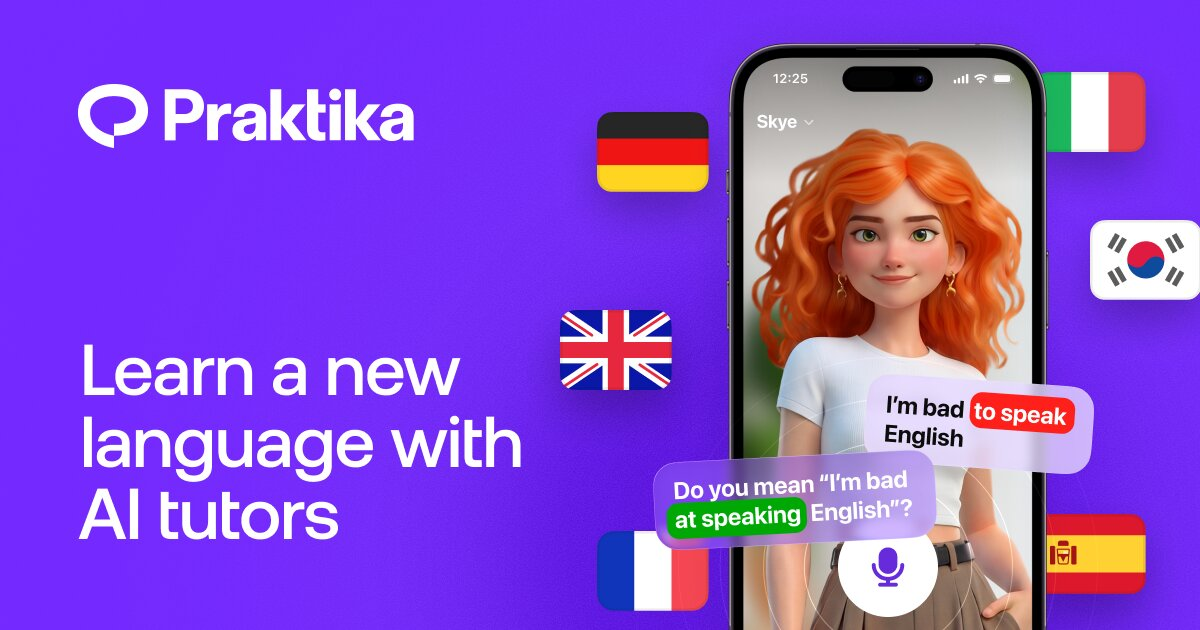
Praktika is the best app to learn French overall because every session is a spoken conversation in French with a human-like AI tutor. You speak from your first lesson, and the tutor answers, keeps the conversation going and corrects you as you talk.
Corrections cover pronunciation, grammar and word choice, and each one shows a better way to say it plus a short explanation of the mistake. Dedicated pronunciation feedback looks at rhythm, fluency and accent mistakes, which matters in a language where one sound can change the word you meant.
Beginners don't need any French to start. The tutor explains in your native language and switches to French gradually, while your study plan adapts to your level and goal, whether that's a transfer to Montreal, a move to Paris or a summer in Provence.
You can set a preferred speaking speed and raise it as your ear improves, then learn French with an AI tutor in sessions that average 12 minutes, short enough for a commute. On average, 73% of active learners gain a full CEFR level in about 20 hours of practice.
Best App to Learn French: In-Depth Review & Comparison
These are the best apps to learn French in 2026, reviewed one by one on who each suits, what it does well, where it falls short and what users say about it.
The order reflects how well each app gets a beginner speaking French with confidence, starting with the strongest all-round pick.
1. Praktika
Overview
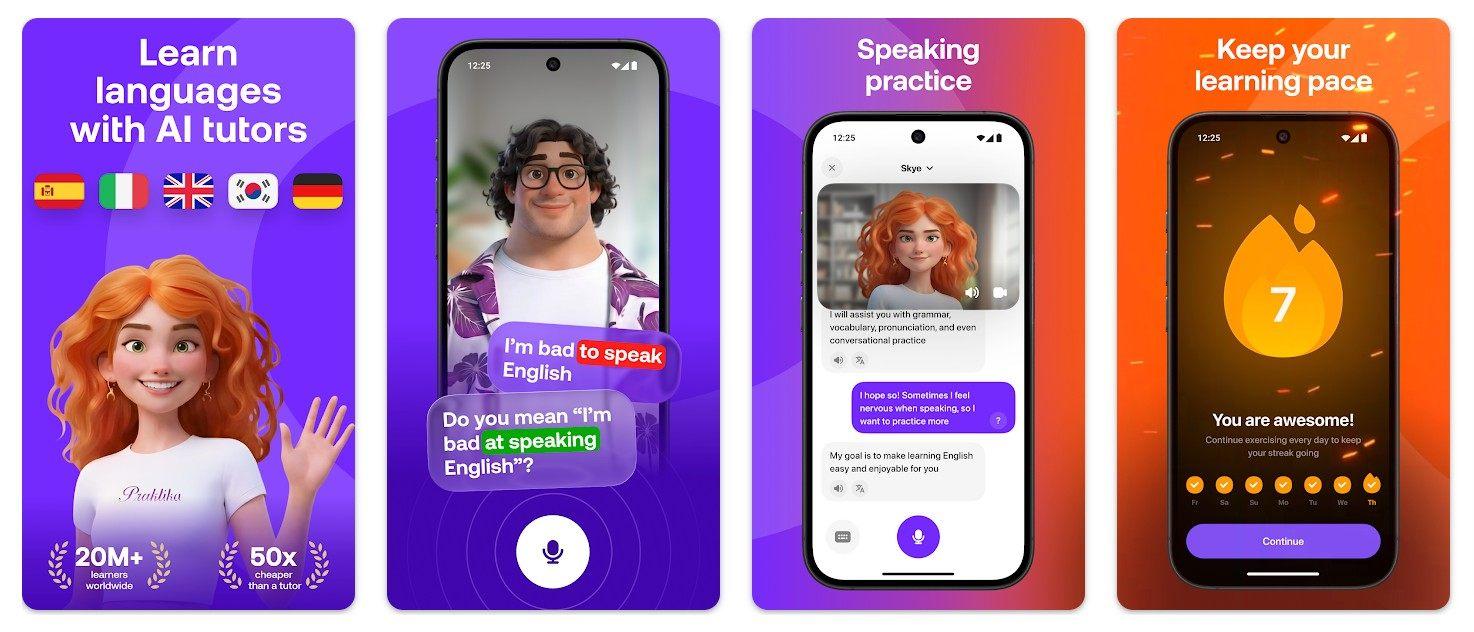
Praktika is an AI tutor app that gets you speaking French out loud from the first session. You talk with human-like AI tutors who listen, reply and correct you in real time, and who remember your goals, mistakes and vocabulary from earlier lessons.
Each tutor has a personality, a backstory and a natural accent, so practice feels like catching up with someone who knows you. Sessions average 12 minutes, which fits a bus ride, a train commute or the wait before a meeting.
More than 30 million people have learned with Praktika across 200+ countries and territories, and around 2 million use it every month. OpenAI featured Praktika as a case study in January 2026 for its tutoring agents, which adapt lessons to each learner's progress and conversation context.
Ideal For
Praktika is the strongest pick for learners who need to speak French soon and can practice in short sessions. It fits these groups best:
- Professionals relocating to Montreal or Paris who need French for coworkers, meetings and daily errands
- Complete beginners who want explanations in their own language while they start speaking
- Commuters who can spare 10 to 15 minutes most days on a phone
- Learners who studied French at school and freeze when someone replies at full speed
- Travelers with a trip to France or Quebec booked a few weeks out
It also suits shy learners who want to make their first mistakes in private. You can practice ordering a coffee or introducing yourself to a new team as many times as you like before you try it for real.
Top Features
Praktika's features are built to increase how much French you speak and how useful the feedback on it is.
- AI tutors with persistent memory: Your tutor remembers your goals, recurring errors and new words, so each conversation picks up where the last one ended.
- Instant, gentle corrections: Pronunciation, grammar and word choice are corrected as you speak, with a better phrasing and a short explanation, so slips in gender agreement and verb endings get caught early.
- Pronunciation feedback: Dedicated feedback on rhythm, fluency and accent mistakes shows you what to work on before you try it with a native speaker.
- Adjustable speed and feedback style: Choose Soft, Balanced or Strict feedback plus your preferred accent and speaking speed, then speed up as your ear catches up with native French.
- Custom Topics and uploads: Upload a document, photo, audio or video clip, such as a work script or a Montreal apartment listing, and practice it as a conversation with your tutor.
A Practice tab adds ready-made scenarios like ordering at a restaurant, and a Dictionary tab keeps every word you save in one place.
Why We're the Best App to Learn French
Praktika trains the French skill most apps leave for later: answering out loud, in full sentences, with feedback. That's what a beginner needs to hold a first conversation with a coworker, a landlord or a neighbor in Montreal, and it's what makes Praktika the best French language learning app for learners with a deadline.
It's also built to keep you going past the first month. Short sessions, a plan that adapts to your pace and tutors who remember you make a daily habit easier to keep, and every session is scored so you can see your progress.
Progress maps to CEFR levels from A1 to C2, and 73% of active learners gain a full CEFR level in about 20 hours of practice, on average. Praktika's study of more than 125,000 learners also found that many short sessions outperform a few long ones, which suits commute practice.
Pros
Praktika's strengths come from putting spoken French at the center of every session.
- Open spoken conversations in French from the first lesson
- Real-time feedback on pronunciation, grammar and word choice
- Tutors that remember your context and adapt to your pace
- Native-language explanations for complete beginners
- 14 languages included, so you can add Spanish or German later
Together, they turn every session into speaking practice with feedback.
Cons
No app suits everyone, and these are the situations where Praktika may not be your first choice.
- You need an official French test result: Praktika tracks your CEFR level but doesn't issue certificates and isn't a certified pathway for exams such as the DELF or TEF Canada.
- You only want to study on a computer: Praktika runs on iPhone and Android today, and its web app is still in testing.
- You want a human teacher in every lesson: Tutor marketplaces such as italki connect you with live French teachers.
If your main goal is speaking French with confidence before a move, these trade-offs rarely get in the way.
Customer Reviews
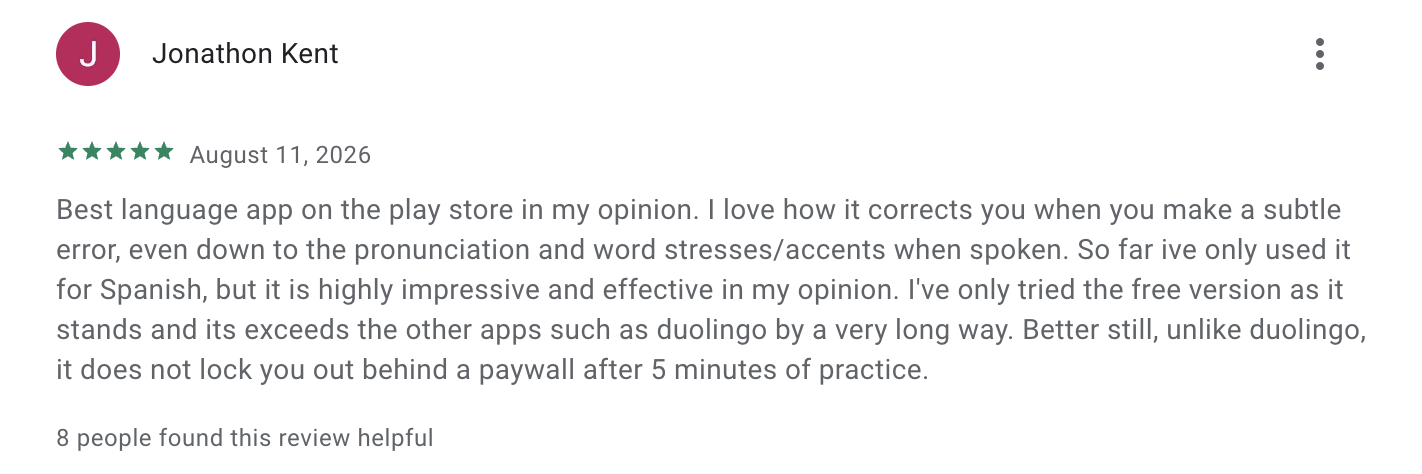
Praktika holds a 4.8-star average across more than 1.2 million ratings on the App Store and Google Play. Reviewers say the tutors sound real, that corrections reach down to pronunciation and word stress, and that practice fits around their day with no appointments.
French learners are part of that story. One US App Store reviewer wrote that "the missing ingredient in my French study was speaking," and another described going from only reading French to finally speaking it.
Final Verdict
Praktika is the best app to learn French for beginners who need to speak soon. It combines real conversation, instant feedback and a tutor that remembers you, in sessions short enough for a daily commute.
If you're preparing for a move to Montreal or Paris, it turns ten to fifteen minutes a day into French conversation practice with feedback on every sentence. Start with the setup quiz, pick your goal and let the plan build from there.
2. Duolingo
Overview
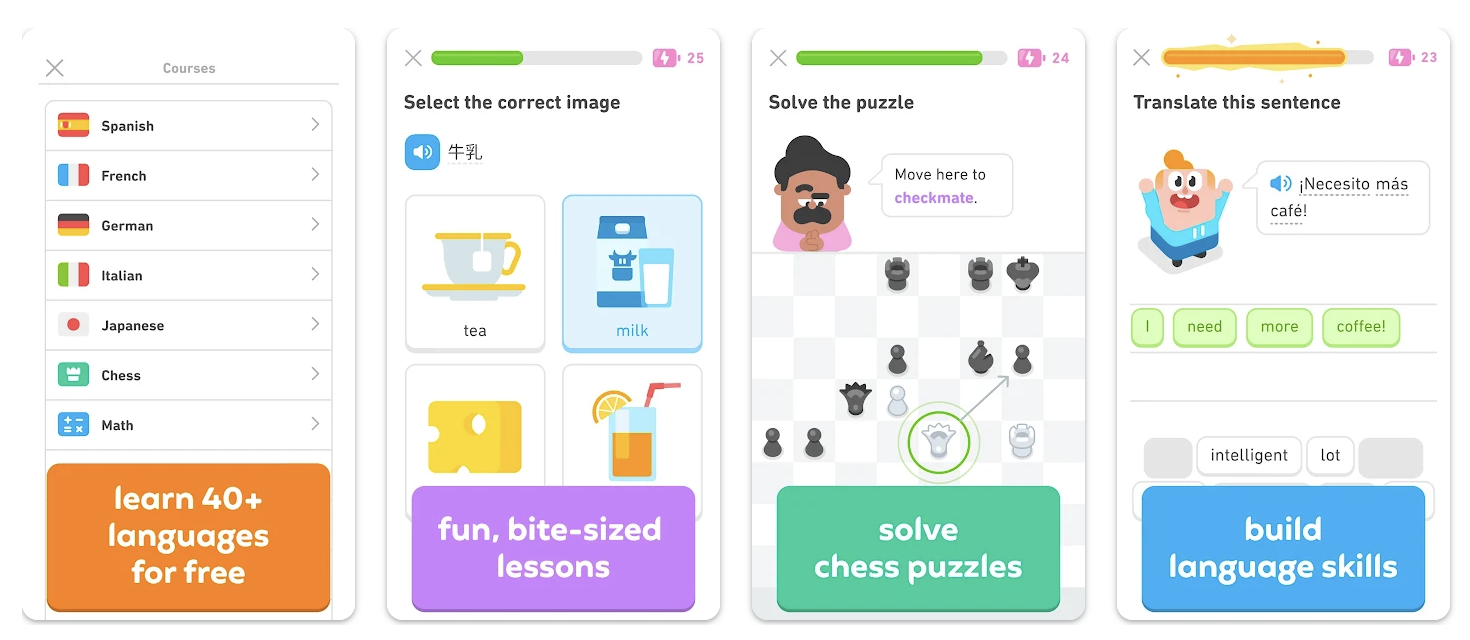
Duolingo is the most downloaded education app in the world and the best-known name in language learning. Founded in Pittsburgh in 2011, it teaches through short game-style lessons with points, streaks, leagues and a green owl that nudges you back each day.
French is one of its headline courses among 40+ languages, named next to Spanish in the app's own subtitle, and the app now covers chess, math and music too. Lessons mix reading, listening, writing and short speaking exercises, and paid tiers add extras, including AI features such as Video Call with its character Lily in select courses.
Ideal For
Duolingo works best for learners who want an easy, low-pressure way into French.
- Casual learners curious about French before committing
- Budget-conscious learners who want a free core course
- Habit builders who respond to streaks and rewards
- Families learning French together
It's less suited to beginners who need to hold French conversations at work within a year.
Top Features
Duolingo's features are designed to keep you coming back.
- Bite-sized lessons: Short exercises across reading, listening, writing and speaking
- Streaks, XP and leagues: Game mechanics that reward daily practice
- Stories and practice hub: Extra reading, listening and review activities
- Max tier: AI features such as Video Call in select courses
These tools make it easy to fit French vocabulary into the gaps in a busy day.
Why It Stands Out
Duolingo stands out for reach and motivation. Its free core course and game design have introduced hundreds of millions of people to a new language, and French is one of its most visible courses.
It's one of the smartest starting points for building a French vocabulary habit. Many learners keep it running next to a speaking-focused app.
Pros
Duolingo's strengths are access and engagement.
- Free core French course
- Habit-forming streaks and rewards
- Short lessons that fit any schedule
- Steady addition of new vocabulary
For a first daily habit in French, few apps match it.
Cons
Duolingo's limits show up when you try to speak French with a real person.
- Exercises train recognition more than spoken production
- Little explanation of grammar rules such as gender or verb tenses
- The energy system cuts practice short in the free version
- Speech recognition misses short French words, according to one learner
Many learners keep long streaks and still struggle to answer a simple question at native speed.
Customer Reviews
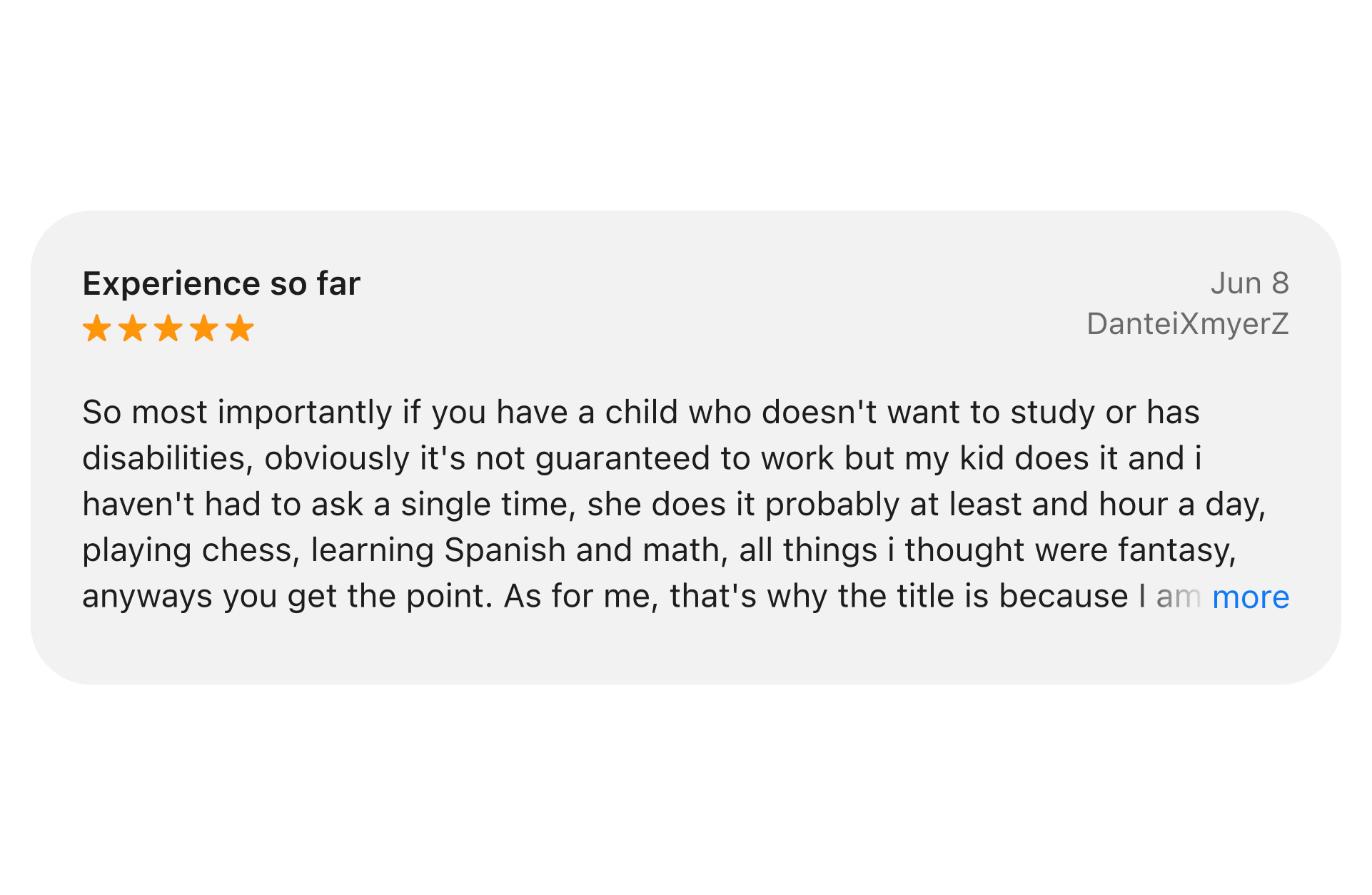
Duolingo holds 4.7 stars on the US App Store (5.5M ratings, Editors' Choice) and 4.8 stars on Google Play (51M reviews, 500M+ downloads). Users praise the game design, the steady flow of new vocabulary and how engaging it is for families.
Recent complaints focus on the energy system, reward clutter, bugs, thin grammar explanations and billing surprises after trials. One French learner wrote that the app doesn't detect short words well, even after many tries.
Final Verdict
Duolingo is a great free starting point for casual learners and families who want a fun daily French habit. Its range of languages and extra subjects is wider than almost any other app.
It isn't built to make you a confident French speaker by a deadline, though. Learners heading to Montreal or Paris will need a speaking-focused app alongside it.
3. Babbel
Overview
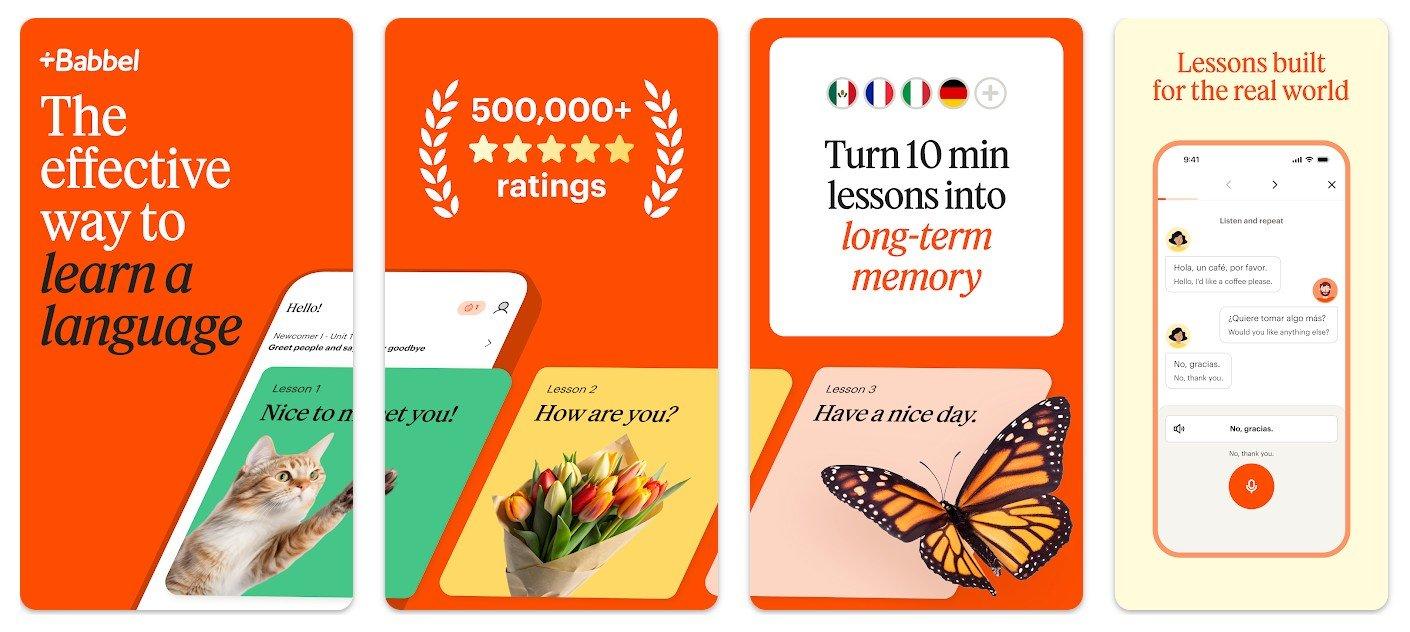
Babbel is a Berlin-based language app that teaches through structured, grammar-led courses. Its lessons are built by more than 200 language experts and tailored to your native language, so an English speaker learning French gets different lessons from a German speaker.
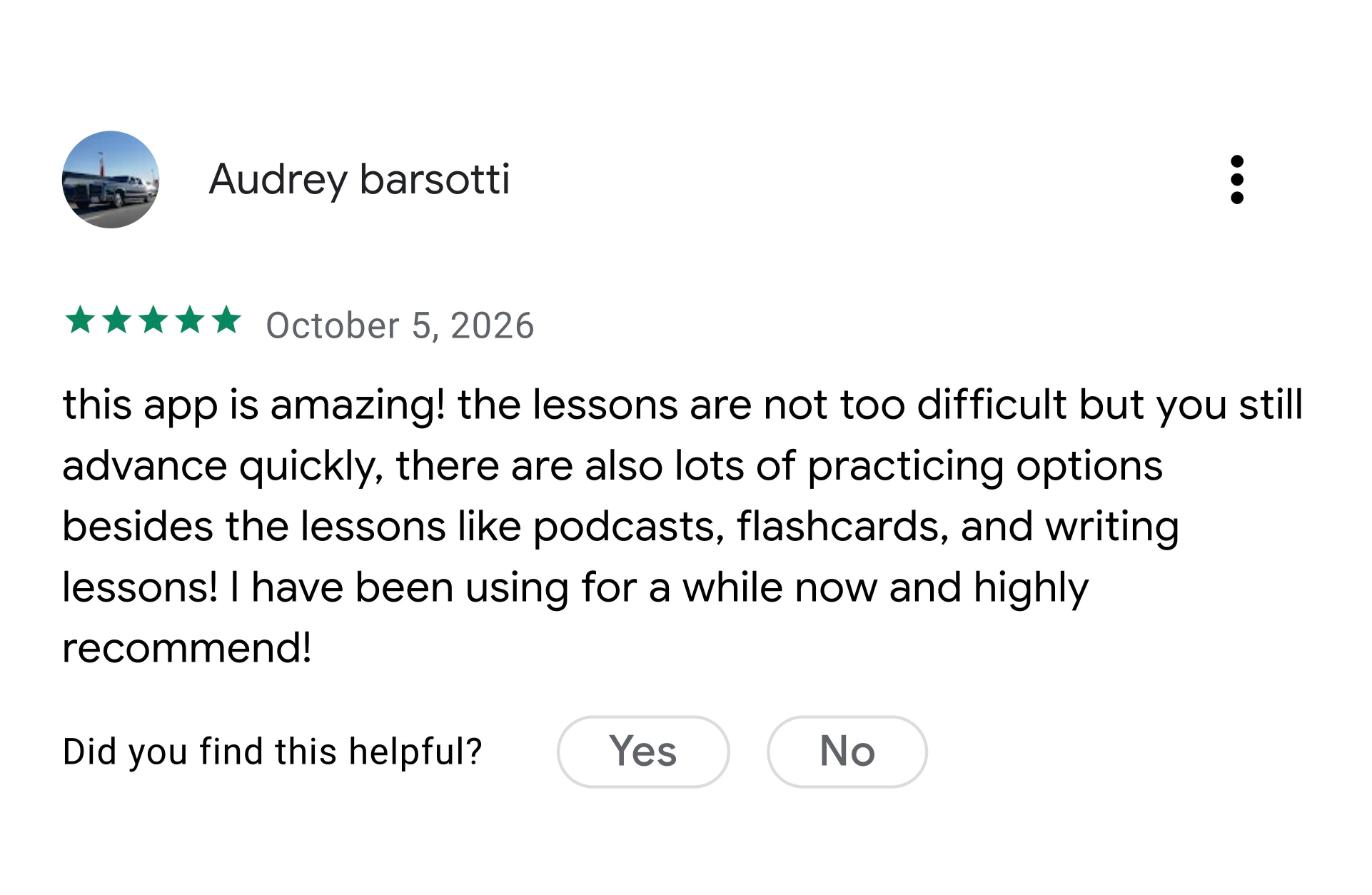
Babbel teaches 14 languages, and French is one of its full courses. Short lessons are built around real-life dialogues, with podcasts, flashcard-style review and writing lessons for extra practice.
Ideal For
Babbel suits learners who want to understand why French works the way it does.
- Adults who like grammar explained, such as when to use the passé composé
- Beginners building foundations before they need to speak at work
- Self-paced learners who want to choose their own path
- Travelers who want practical dialogues for daily situations
It's less suited to learners who want to practice open French conversation every day.
Top Features
Babbel's features focus on clear, practical lessons.
- Native-language tailoring: Lessons adapted to the language you already speak
- Dialogue-based lessons: Real situations, from shopping to small talk
- Grammar tips: Explanations built into each lesson
- Spaced review: Flashcard-style practice to keep words fresh
- Podcasts: Listening practice for hands-free learning
Together, they give French learners a course-like structure inside an app. The podcasts are a useful extra for commuters who want to keep listening between lessons.
Why It Stands Out
Babbel stands out for the quality of its explanations. Reviewers often say it explains far more than Duolingo, with lessons that build understanding of tricky French grammar.
It's also flexible, since you can follow the guided path or pick the topics you need. For a grammar-first French foundation, it's one of the strongest choices.
Pros
Babbel's strengths are structure and clarity.
- Clear grammar explanations in context
- Lessons adapted to your native language
- Practical, real-life dialogues
- Podcasts and writing lessons for extra practice
It's one of the most respected course-style apps for French.
Cons
Babbel has weaknesses in speaking practice and depth.
- Speech recognition fails even native French speakers, according to one reviewer
- Only one free lesson before subscribing
- Thin content at advanced levels
- Limited open conversation practice
It builds French knowledge well, and most learners need a conversation app to turn that knowledge into speech.
Customer Reviews
Babbel holds 4.7 stars on the US App Store (756K ratings) and 4.4 stars on Google Play (1.13M reviews, 50M+ downloads). Reviewers value its explanations, its no-games format, the self-paced structure and its podcasts and writing lessons.
The main complaints concern speech recognition, with one reviewer saying it fails "even native french speakers." Others mention the early paywall and weaker content beyond the intermediate level.
Final Verdict
Babbel is an excellent pick for adults who want grammar-first French lessons in short sessions. It turns ten minutes a day into a solid understanding of how French sentences fit together.
Its speaking practice is limited, and speech recognition frustrates many users. Learners preparing to talk with French speakers soon will need a conversation-focused app as well.
4. Busuu
Overview
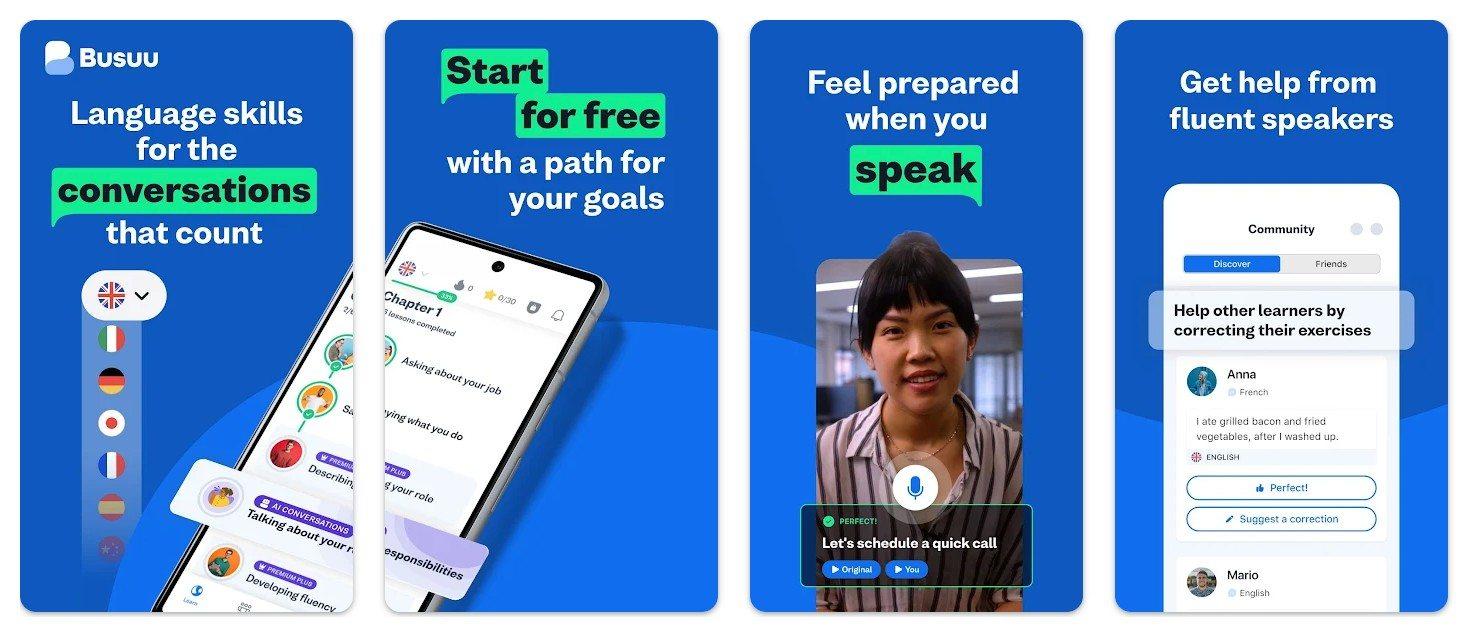
Busuu is a language app that combines expert-designed courses with feedback from a global community of native speakers. You complete exercises, and fluent French speakers correct your writing and recorded speech, while you help learners of your own language in return.
French is one of its 14 languages. Lessons include grammar explanations, cultural notes, videos of real speakers and regular checkpoints, and a personalized study plan estimates when you'll reach your goal.
Busuu is a Chegg service. AI-powered Conversations are available on its Premium Plus tier for some languages, so check whether French is included before you upgrade.
Ideal For
Busuu is a good fit for French learners who want human input without booking a tutor.
- Learners who want corrections from native French speakers
- Beginners who like structure and clear checkpoints
- Grammar-minded learners who want explanations in context
- Culture-curious learners who enjoy notes on how French is used day to day
It's less suited to learners who want daily open conversation in French.
Top Features
Busuu's features balance self-study with real feedback.
- Community feedback: Native speakers correct your exercises
- Grammar and culture: Explanations and cultural tips inside lessons
- Adaptive study plan: Goals, timelines and checkpoints
- Real-speaker videos: See how French speakers form each sound
The community remains its signature feature. Watching real speakers also helps with sounds like the French u, which are easier to copy when you can see them.
Why It Stands Out
Busuu stands out for bringing real people into a self-study app. Getting your French corrected by native speakers adds a layer of feedback few apps offer.
Reviewers also say its lessons go deeper on grammar and context than gamified apps. For a structured French course with a human touch, it's one of the smartest choices.
Pros
Busuu's strengths come from people and structure.
- Corrections from native French speakers
- Grammar explanations and cultural notes
- A study plan with goals and checkpoints
- Videos that show how speakers pronounce words
It's one of the easiest ways to get human feedback inside an app.
Cons
Busuu has limits, especially on the free plan.
- Frequent ads in the free version
- Speech recognition glitches reported by users
- AI conversation limited to the top tier and some languages
- Community feedback takes time to arrive
Daily speaking practice isn't its strong point. You'll get corrections on what you record, with little back-and-forth conversation.
Customer Reviews
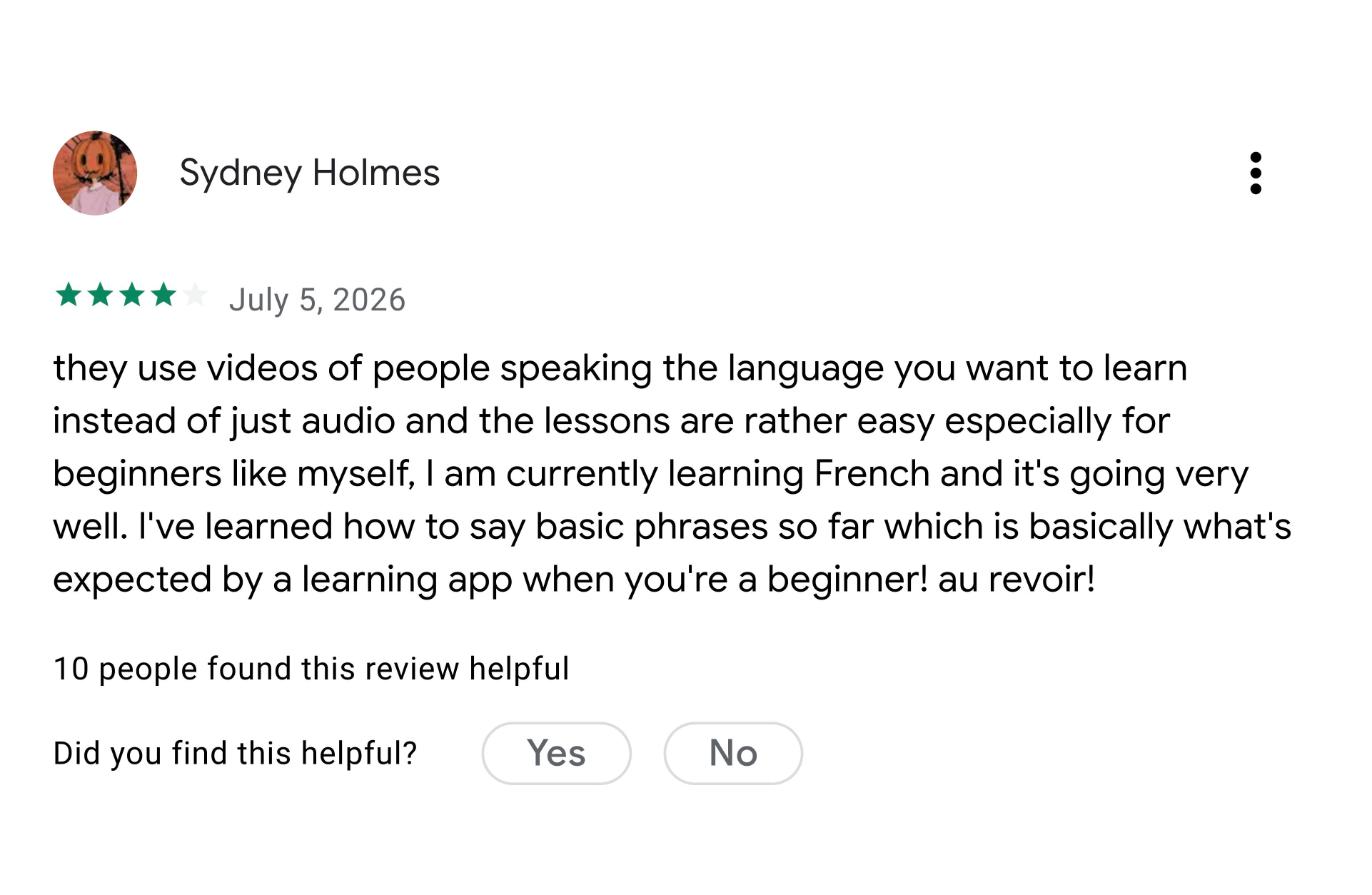
Busuu holds 4.7 stars on the US App Store (101K ratings) and 4.7 stars on Google Play (1.24M reviews, 50M+ downloads). Users praise the community corrections, grammar detail, cultural notes and videos of real speakers, and one beginner learning French said the lessons are easy to follow.
The most frequent complaints are about ads in the free version, speech recognition problems and limited AI conversation for some languages.
Final Verdict
Busuu is a smart choice for French learners who want a structured course plus corrections from native speakers. Its videos and cultural notes add context that gamified apps often skip.
The free version's ads and the limited spoken practice hold it back. Beginners who need to speak French with confidence within a year will need more conversation than Busuu provides.
5. Rosetta Stone
Overview
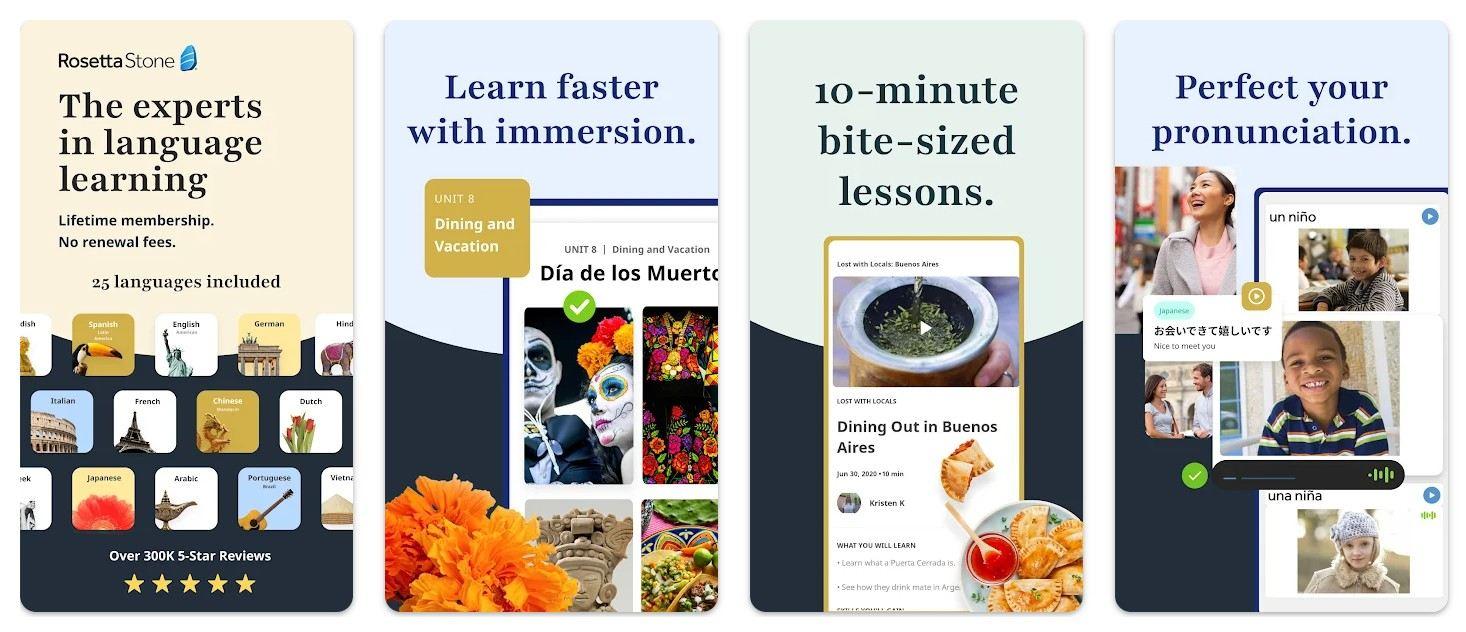
Rosetta Stone pioneered immersion-based language software and has taught languages since 1992. Its method skips translation, so you connect French words and sentences to images, the way children learn their first language. The company is now part of IXL Learning.
French is one of 25 languages, with lessons of about 10 minutes, pronunciation practice and offline downloads. The Rosetta Stone Classic app now serves current subscribers and existing enterprise or education users, while new learners start with Rosetta Stone Sapphire.
Ideal For
Rosetta Stone suits learners who enjoy learning French through context.
- Visual learners who think in pictures
- Learners who want total immersion without English translations
- Offline learners who study on planes or underground trains
- People who dislike gamified apps and want a quiet study space
Learners who want French grammar explained step by step may find it frustrating.
Top Features
Rosetta Stone's features revolve around immersion.
- No-translation lessons: Pictures and French only
- Pronunciation checks: Speech feedback on your spoken answers
- Short lessons: Around 10 minutes each
- Offline mode: Download lessons and study anywhere
The method pushes you to think in French from the first unit.
Why It Stands Out
Rosetta Stone stands out for its pure immersion approach. You build direct links between French words and meaning, which many visual learners find intuitive.
It's also calm and ad-free, and reviewers often describe it as more thorough than gamified apps. For immersion without distractions, it's one of the strongest choices.
Pros
Rosetta Stone's strengths come from its method.
- Immersive, translation-free French lessons
- Pronunciation practice in every unit
- Offline downloads
- An ad-free study space
It's a focused option for learners who like to learn by seeing.
Cons
Rosetta Stone's approach doesn't work for everyone.
- No grammar explanations
- Speech recognition often rejects correct answers, according to users
- Early vocabulary isn't always practical for daily life
- Confusion during the move from Classic to Sapphire
Learners may understand more French than they can say.
Customer Reviews
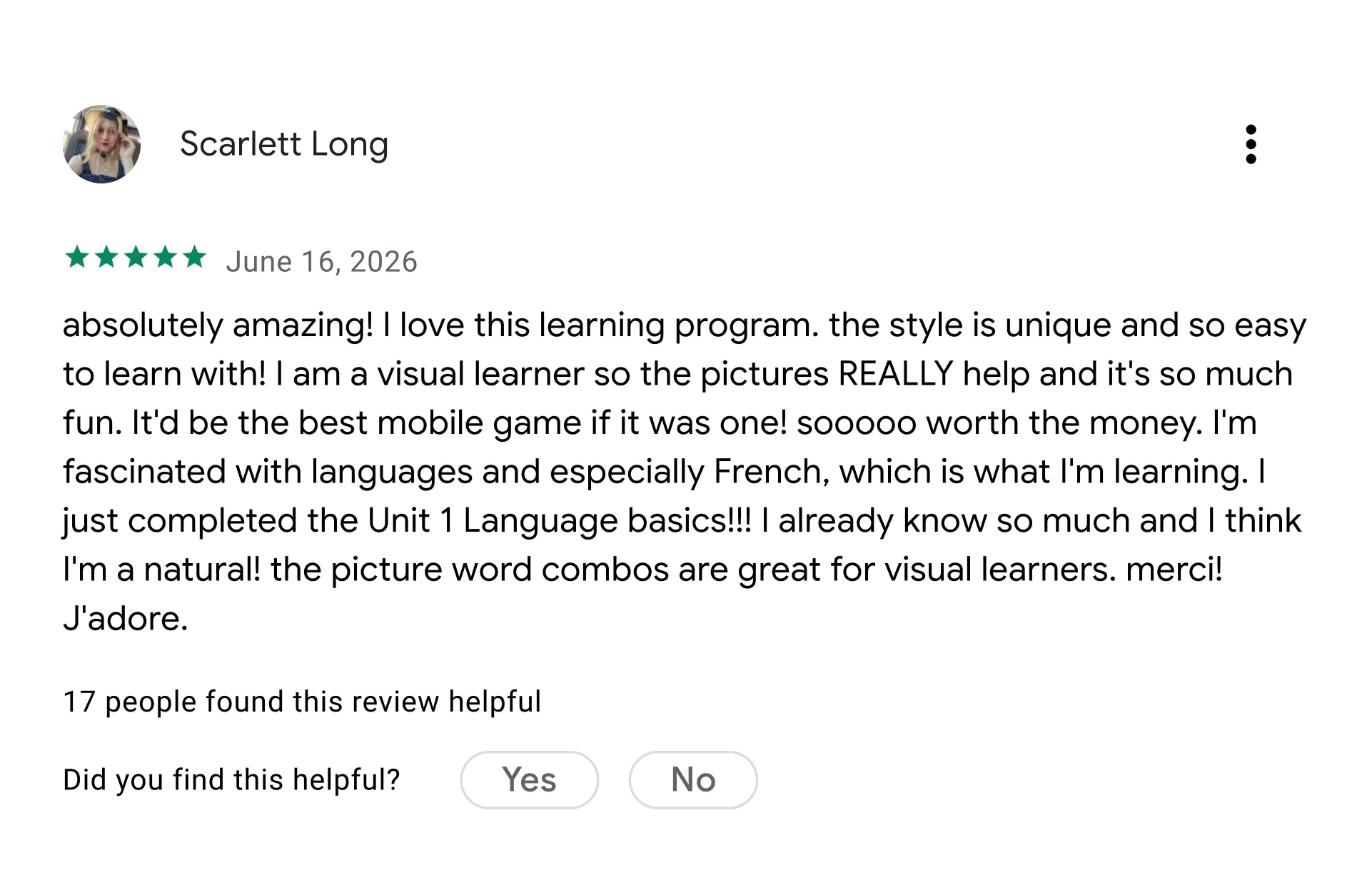
The Rosetta Stone Classic app holds 4.8 stars on the US App Store (239K ratings) and 4.8 stars on Google Play (406K reviews, 10M+ downloads). Users praise its immersion method, pronunciation audio, offline mode and calm lessons, and one French learner said the picture and word pairs suit visual learners.
The main complaints concern speech recognition, the lack of grammar teaching and access problems for lifetime subscribers moving to the newer app.
Final Verdict
Rosetta Stone is a good fit for patient, visual learners who want French immersion without distractions. It's handy offline, too.
Without grammar explanations or open conversation, many learners plateau. Beginners preparing to speak French at work or around town will need more active speaking practice.
6. Speak
Overview
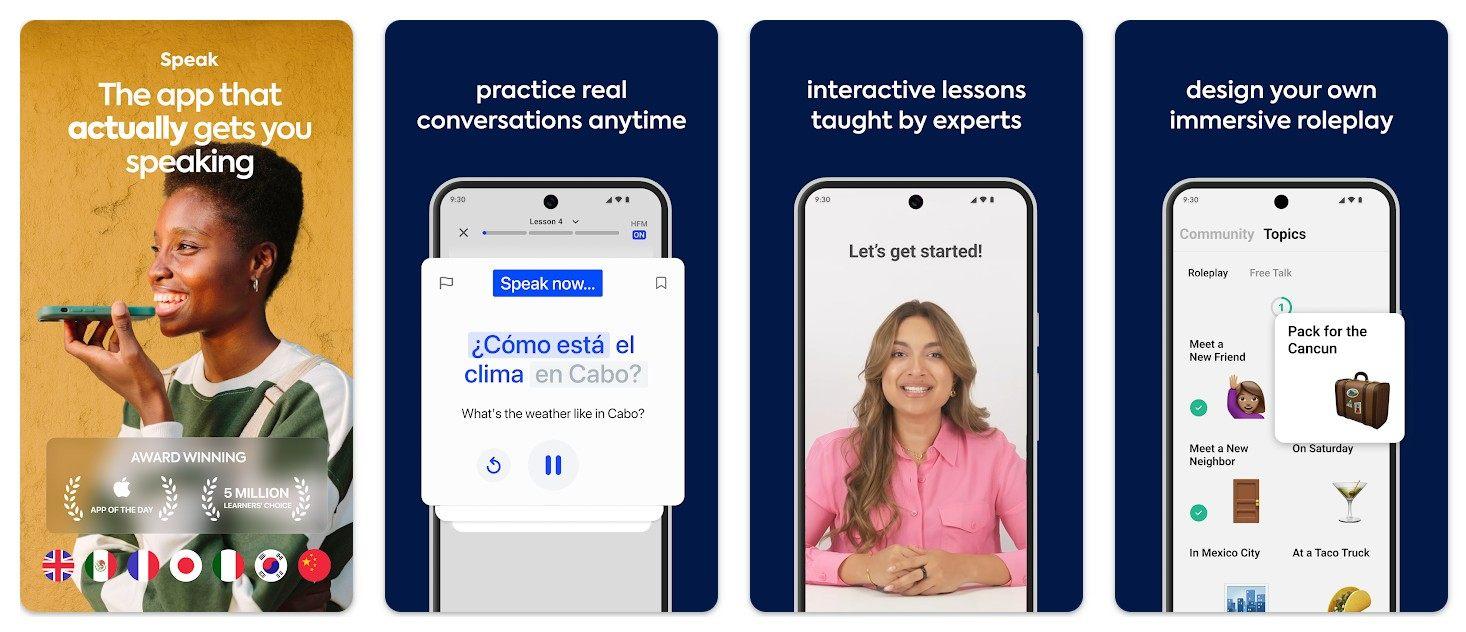
Speak is a speaking-first AI language app from Speakeasy Labs. It was built on the idea that most apps don't get people talking, so its lessons focus on saying full sentences out loud with instant feedback.
French is one of seven languages, alongside English, Spanish, Italian, Japanese, Korean and Chinese. Lessons mix teacher videos, AI speaking drills, roleplays you design yourself and an AI tutor that answers questions, and the company is backed by the OpenAI Startup Fund.
Recent updates added adaptive lessons, clearer views of your level and audio-first roleplays designed to feel like real conversations.
Ideal For
Speak is a good fit for French learners who want to start talking quickly through guided drills.
- Speaking-focused learners who like repeating and adapting model sentences
- Learners short on time who like five-minute lesson chunks
- Intermediate learners who want to skip ahead to their level
- Learners who want custom roleplays for specific situations
If you later want a language outside its seven, you'll need a second app.
Top Features
Speak's features keep you talking for most of each lesson.
- Speaking lessons: Most of each lesson is spent saying French out loud
- AI roleplays: Custom scenarios with an AI partner
- Instant feedback: Corrections right after you speak
- AI tutor: Questions about grammar and vocabulary answered mid-lesson
- Playback tools: Slow down audio and redo lessons
Slow-down audio is handy for French, where native speech runs fast.
Why It Stands Out
Speak stands out for putting speaking first in every lesson. Reviewers say they form sentences with confidence within days and praise its detailed, immediate feedback.
Its roleplays add a sense of real conversation to structured content. Within its seven languages, it's one of the strongest speaking-first options.
Pros
Speak's strengths are focus and feedback.
- Speaking practice in every lesson
- Instant feedback on spoken answers
- Custom AI roleplays
- Slow-down audio and lesson replays
For drilling French phrases out loud, it offers a lot of speaking time.
Cons
Speak's limits come from range and consistency.
- Seven languages only
- Speech recognition can be too strict or too lenient
- Only one or two free lessons
- Content can run out at advanced levels
Open-ended conversation happens mainly inside roleplays.
Customer Reviews
Speak holds 4.8 stars on the US App Store (64K ratings) and 4.7 stars on Google Play (125K reviews, 10M+ downloads). Users highlight its detailed instant feedback, immersive roleplays, slow-down audio and how quickly they start building sentences.
The main complaints are the quick paywall, uneven speech recognition and content running out at advanced levels.
Final Verdict
Speak is a strong choice for learners who want structured French speaking drills in short daily sessions. Its feedback keeps practice active.
Its narrow language list and uneven recognition limit it. Learners who want open conversation, native-language explanations or a tutor that remembers them will find a better fit elsewhere.
7. Pimsleur
Overview
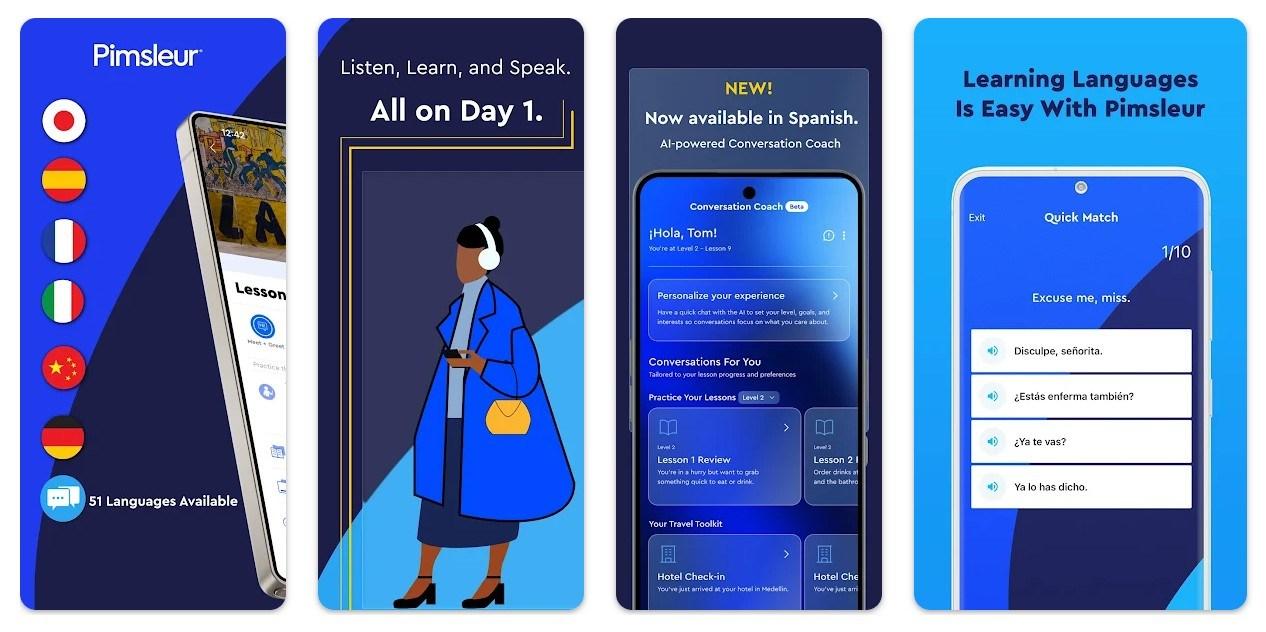
Pimsleur is an audio-based course that teaches you to speak by listening and answering out loud. Each 30-minute lesson prompts you to recall phrases at set intervals, using the Pimsleur Method that Simon & Schuster has published for around 50 years.
The app covers 51 languages, and French is one of the languages sold as a single-language All Access subscription. Flash cards, quick-match games, short Minis and a Pronunciation Challenge add practice between audio lessons.
French is also one of the first languages with Pimsleur's AI Conversation Coach (Beta), which builds AI speaking practice on your lessons for All Access learners.
Ideal For
Pimsleur is ideal for learners who want to practice French hands-free.
- Commuters who travel by car or walk with headphones
- Auditory learners who learn best by hearing and repeating
- Beginners who want a good French accent from the start
- Travelers preparing for spoken exchanges
Visual learners may miss written support. The lessons ask for 30 focused minutes, which suits a longer commute better than a five-minute break.
Top Features
Pimsleur's features build on its audio method.
- 30-minute audio lessons: Each builds on the one before
- Spaced recall: Phrases return at set intervals
- Pronunciation Challenge: Focused speaking practice
- AI Conversation Coach (Beta): AI speaking practice for French learners
The audio lessons remain the heart of the course.
Why It Stands Out
Pimsleur stands out for making French listening and speaking fit into daily life. You answer out loud in every lesson without looking at a screen, which suits a car commute.
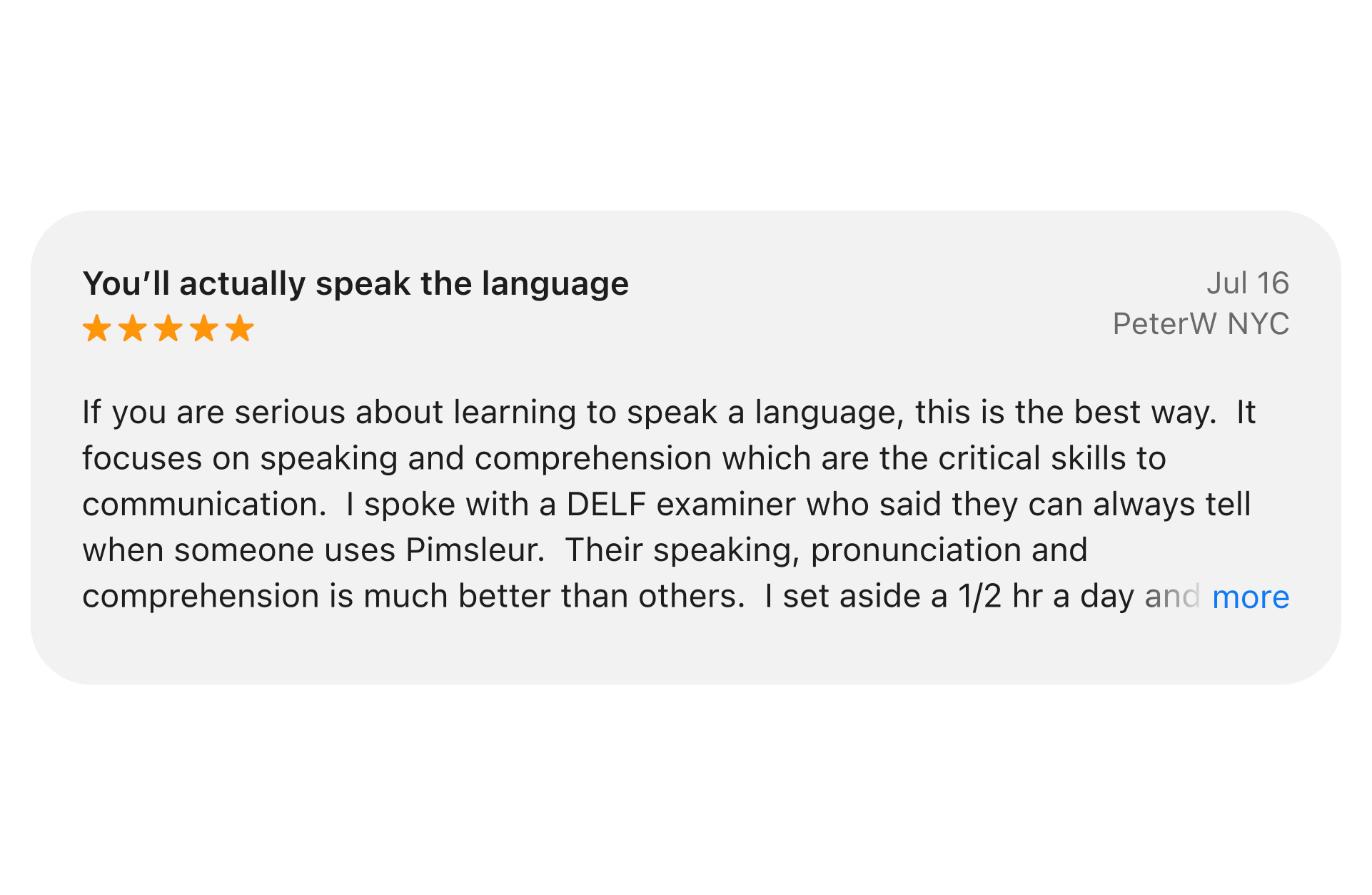
One reviewer said a DELF examiner told them they can always tell when someone has used Pimsleur. For training your ear and accent, it's one of the smartest choices.
Pros
Pimsleur's strengths come from its method.
- Hands-free audio lessons
- Speaking out loud in every session
- Native-speaker audio and a strong pronunciation focus
- AI conversation practice now available for French
Few apps fit into a car commute this well.
Cons
Pimsleur's format has trade-offs.
- Fixed pacing, with pauses some find too short
- Few visuals and limited reading
- Scripted dialogues with little open conversation
- Less effective at higher levels, according to some users
Most practice follows set scripts. Reading and writing French get little attention.
Customer Reviews
Pimsleur holds 4.7 stars on the US App Store (30K ratings) and 3.9 stars on Google Play (16.7K reviews, 1M+ downloads). Learners praise its focus on speaking, pronunciation and listening, the hands-free format and its cumulative lessons.
Complaints cover plan costs, short pauses that leave little time to think, subscription management and weaker results at higher levels.
Final Verdict
Pimsleur is a strong pick for learners who want to build French listening and pronunciation on the go. Its method is proven and fits a daily commute.
Scripted lessons and fixed pacing limit flexible conversation. Learners who want open, personalized speaking practice will get more from a conversation-first app.
8. Memrise
Overview
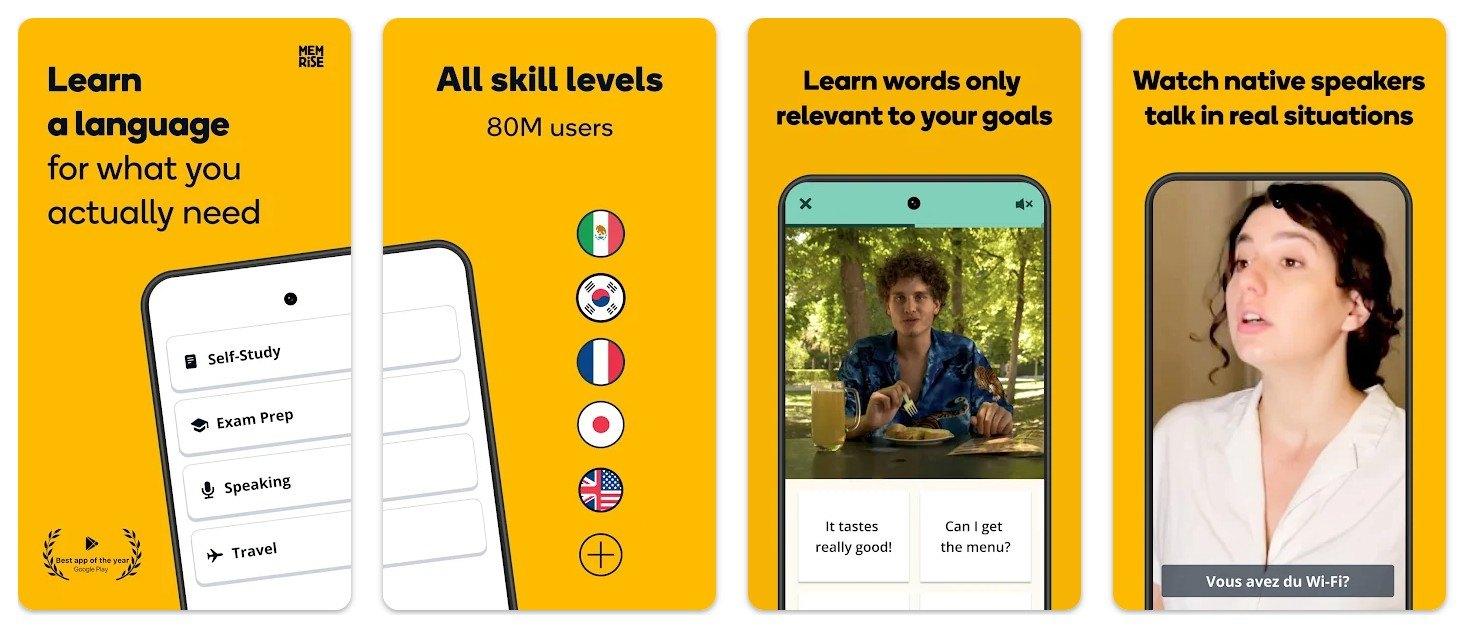
Memrise is a language app built around videos of real native speakers. You watch locals use phrases in everyday situations, which trains your ear for French as people speak it.
You start by choosing a goal, such as travel, speaking at work, passing an exam or exploring a culture, and Memrise focuses on the vocabulary for it. Podcasts on topics you pick and an AI conversation exercise add listening and speaking practice.
Memrise says 80 million learners have used it.
Ideal For
Memrise suits French learners who want authentic input.
- Visual and auditory learners who like seeing people speak
- Vocabulary builders focused on useful words
- Travelers preparing for specific situations
- Learners on a budget who want a generous free tier
It's less ideal for learners who want in-depth grammar without a paid plan.
Top Features
Memrise's features focus on real-world language.
- Native-speaker videos: Real people, real accents, real situations
- Goal tracks: Self-study, exam prep, speaking and travel
- AI conversation practice: Daily conversation with an AI chatbot
- Topic podcasts: Listening practice on subjects you choose
The native-speaker videos remain its signature. They're a good way to hear everyday French before you hear it in person.
Why It Stands Out
Memrise stands out for putting real people at the center of learning. Seeing and hearing French speakers helps vocabulary stick and shows how mouths shape each sound.
Reviewers also like that it's less gamified than many rivals, with goals that keep study purposeful. For training your ear, it's one of the smartest choices.
Pros
Memrise's strengths are authenticity and focus.
- Videos of real native speakers
- Goal-based learning paths
- AI conversation practice and podcasts
- A generous free tier
It's a useful companion for learners who want more listening practice.
Cons
Memrise has frustrated some long-time users recently.
- A redesign removed features loyal users liked
- Community courses moved out of the app
- Grammar explanations require a paid plan
- Reports of bugs and slow support
Advanced learners say progress tends to stall.
Customer Reviews
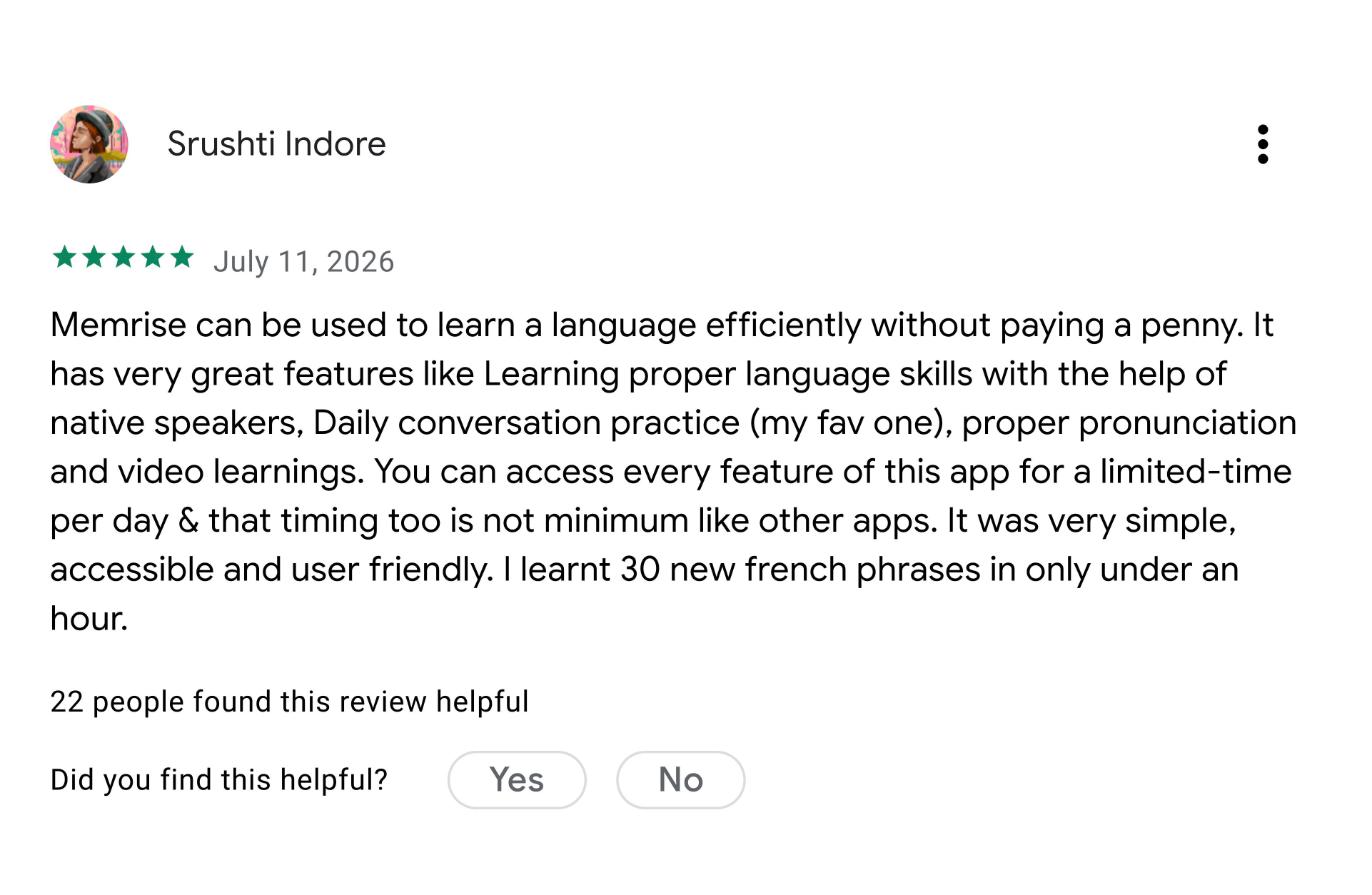
Memrise holds 4.8 stars on the US App Store (217K ratings, Editors' Choice) and 4.6 stars on Google Play (1.57M reviews, 50M+ downloads). Users love the native-speaker videos, the daily conversation practice and the goal-based scenarios, and one reviewer learned 30 new French phrases in under an hour.
Complaints focus on the redesign, the loss of community courses, paywalled grammar and bugs.
Final Verdict
Memrise is a smart pick for learners who want to build French vocabulary and listening skills with real native speakers. Its goal tracks keep study relevant.
The redesign has divided users, and grammar needs a paid plan. Learners who want regular spoken conversation with detailed feedback will need a speaking-focused app too.
9. Mondly
Overview
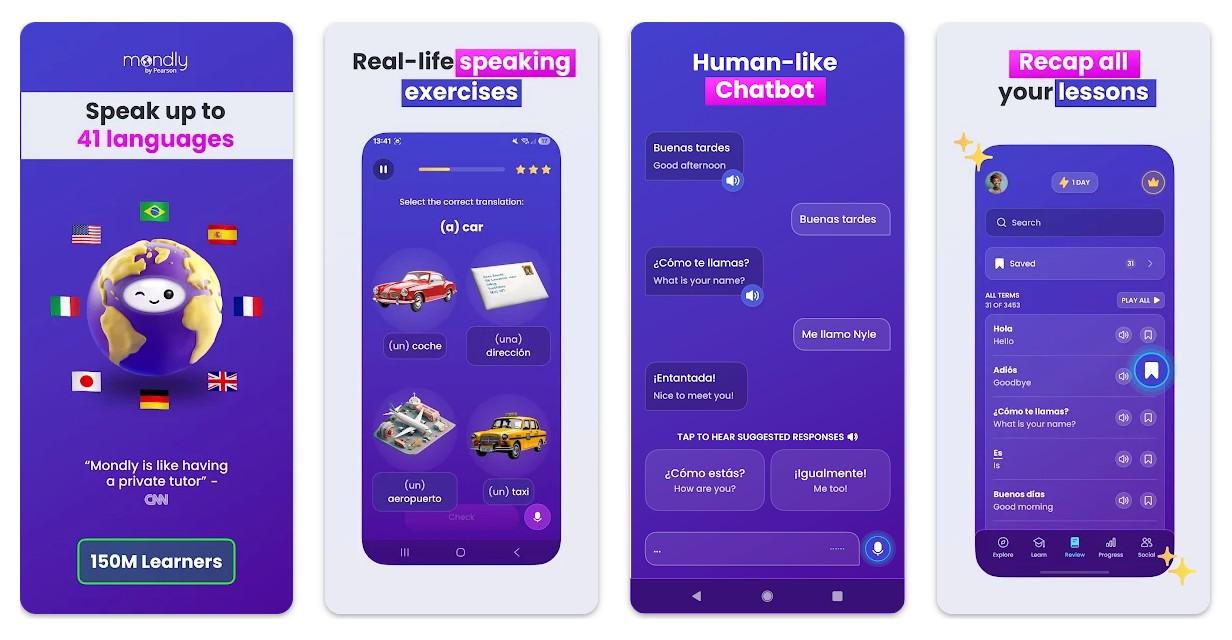
Mondly is a language app from Pearson that teaches 41 languages through short daily lessons. Founded in Romania in 2014 and acquired by Pearson in 2022, it combines vocabulary, grammar and speaking exercises with a human-like chatbot for conversation practice.
French sits among its 41 courses, with a flexible learning path, a hands-free mode and lesson recaps. A separate virtual reality app adds immersive scenarios.
Mondly says 150 million learners have used it.
Ideal For
Mondly suits learners who want variety and range.
- Multilingual learners studying French alongside another language
- Visual learners who like a polished, colorful interface
- Hands-free learners who practice while doing other things
- Casual learners who want short, structured lessons
It's less suited to learners who need French grammar explained in depth.
Top Features
Mondly's features cover the basics of language practice.
- 41 languages: French plus many less common options
- Human-like chatbot: AI conversation practice with corrections
- Hands-free mode: Speaking practice without tapping
- Short daily lessons: Vocabulary, grammar and speaking
Its breadth of languages is a major draw. The chatbot gives beginners a low-stakes first taste of French conversation.
Why It Stands Out
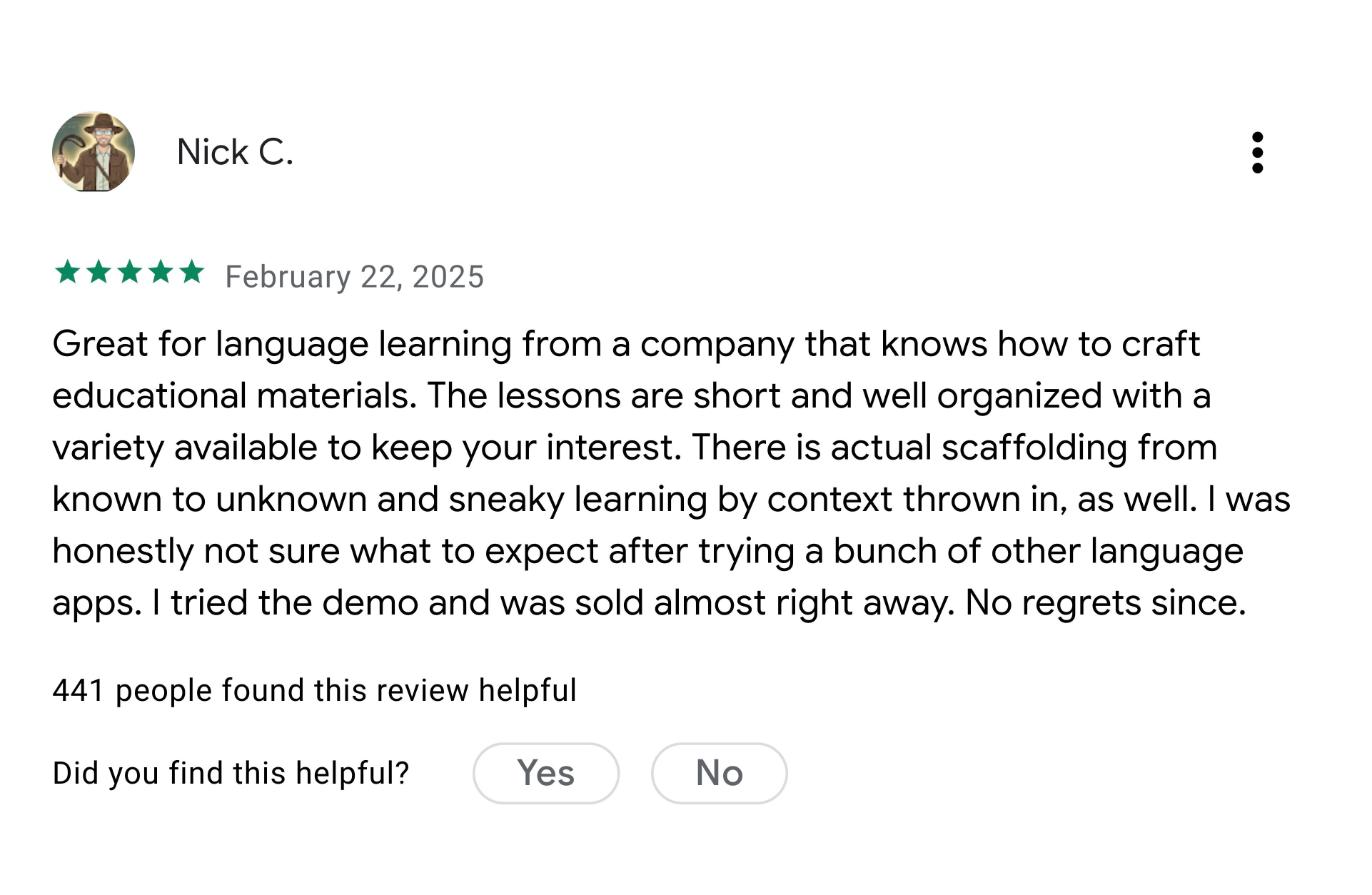
Mondly stands out for range. With 41 languages, it covers options most apps don't, and reviewers praise its scaffolding from known to unknown material.
Its chatbot corrections and hands-free mode add useful speaking practice. For learners juggling French with another language, it's one of the smarter all-rounders.
Pros
Mondly's strengths are range and structure.
- 41 languages in one app
- AI chatbot with corrections
- Hands-free speaking practice
- Short, well-organized lessons
It's a solid all-rounder for multilingual learners.
Cons
Mondly has weaknesses users mention often.
- Speech recognition frequently fails, according to reviewers
- Little grammar explanation
- Course quality varies by language
- Exercises can feel repetitive
Learners often plateau after the basics.
Customer Reviews
Mondly holds 4.7 stars on the US App Store (33K ratings) and 4.4 stars on Google Play (928K reviews, 50M+ downloads). Users praise its well-structured lessons, wide language range, hands-free speaking practice and AI chatbot.
The most frequent complaints concern speech recognition, limited grammar explanations and uneven quality across courses.
Final Verdict
Mondly is a good choice for learners who want French alongside other languages in one well-designed app. Its chatbot and hands-free mode add speaking practice.
Speech recognition issues and thin grammar limit progress beyond the basics. Learners who want to speak French with confidence will likely need a more conversation-focused tool.
10. italki
Overview
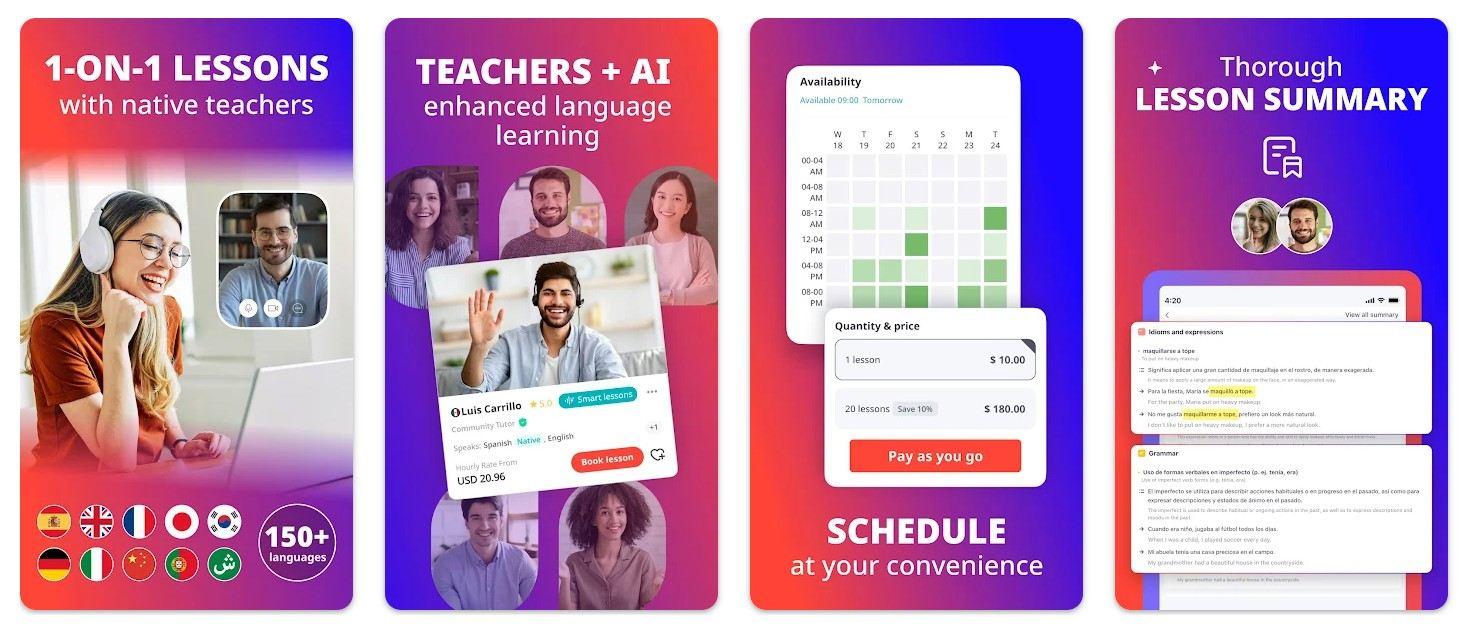
italki is an online marketplace for private language lessons with native teachers. You browse teachers, book one-on-one video lessons at times that suit you, and pay per lesson or by package. italki says more than ten million students have learned with it.
French is one of the main languages it names, among 150+ in total. Teacher profiles show where each teacher comes from, so a learner heading to Montreal can look for a teacher from Quebec and hear the local accent from the start.
Lessons come with summaries of key expressions, grammar and sentence structures, and a free community helps learners find language partners. Recent versions add AI-enhanced tools alongside its teachers.
Ideal For
italki is a great fit for French learners who want personal teaching.
- Learners relocating to Quebec who want a teacher with a Quebec accent
- Professionals preparing for interviews or work in French
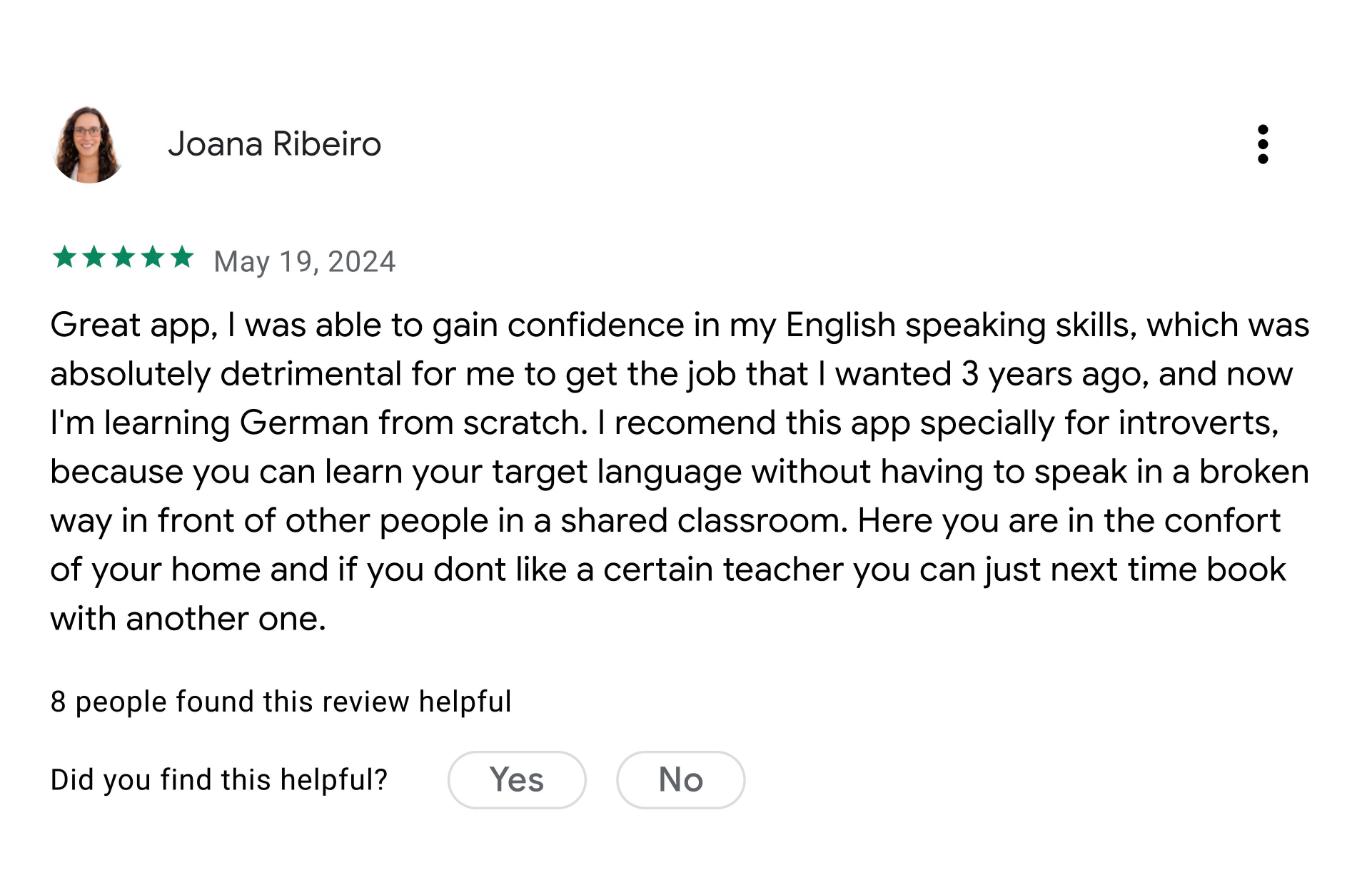
- Introverts who prefer private lessons at home
- Learners who prefer paying per lesson over subscriptions
It's less suited to learners who want daily practice around an unpredictable schedule. Every lesson needs a booked slot with a teacher.
Top Features
italki's features support private tutoring.
- 1-on-1 lessons: Live video sessions with native teachers
- Flexible booking: Single lessons or packages, on your schedule
- Lesson summaries: Key phrases and grammar after each class
- Teacher choice: Switch teachers whenever you like
- Language community: A free space to find practice partners
The marketplace model gives you control over who teaches you.
Why It Stands Out
italki stands out for its range of languages and teachers. Few apps let you book a native French teacher from a specific region on demand.
Reviewers say it helped them build the confidence to speak at work and land jobs. For live human feedback, it's one of the strongest choices.
Pros
italki's strengths are flexibility and choice.
- Private lessons with native French teachers
- Teachers from different French-speaking regions
- Pay-as-you-go booking
- Lesson summaries after class
It's ideal for learners who want human teaching on their own terms. A teacher can also answer questions about local habits that apps rarely cover.
Cons
italki shares the limits of tutor marketplaces.
- High cost per hour compared with apps
- Lessons need scheduling
- Teacher quality varies
- The app lags behind the teaching
Daily speaking practice gets expensive quickly.
Customer Reviews
italki holds 4.8 stars on the US App Store (9.9K ratings) and 4.4 stars on Google Play (18.7K reviews, 5M+ downloads). Learners praise the native teachers, private lessons from home and the freedom to change teachers.
Complaints focus on the app itself, especially tutor search filters and finding saved tutors.
Final Verdict
italki is a strong choice for learners who want native French teachers, including teachers from Quebec, without a subscription. Its flexibility is a real advantage.
The cost and scheduling make daily speaking practice hard to sustain. Many learners pair an AI tutor for daily practice with an occasional italki lesson.
What Makes a Good App to Learn French?
Top-rated French language learning apps share a few traits, whatever their teaching style. The best ones change what you can say and understand after a few weeks, and they keep you practicing long enough for it to matter.
Use these five criteria to judge any app before you commit, especially if a move or a new job sets your deadline.
1. Open Speaking Practice From Day One
French starts to feel natural only after you've said it out loud many times. A good app gets you speaking in full sentences early, in conversations that follow what you want to talk about.
Check how much of a typical session you spend talking. If it's a small fraction, the app will build recognition faster than conversation.
2. Real-Time Feedback on Pronunciation and Grammar
French pronunciation has several traps for English speakers, such as nasal vowels, silent final letters, liaison and the French r. Grammar adds gender agreement and verb endings that change with every subject.
Look for corrections that arrive as you speak, show a better way to say it and explain the mistake. Fixing an error while the sentence is still in your head is how it stops coming back.
3. Listening Practice at a Speed You Can Raise
Native French runs fast, and words blur together in everyday speech. Quebec French adds its own accent and rhythm, which can surprise learners trained only on the French of France.
A good app lets you adjust the speaking speed and raise it as your ear improves. In Praktika, you set a preferred speaking speed and accent at setup and can change them at any time, so you move toward natural pace step by step.
4. A Way In for Complete Beginners
Apps that use only French from the first screen can overwhelm a beginner. Explanations in your native language make the first weeks far less frustrating and help you keep going past month one.
The best approach starts in your language and switches to French gradually. A tutor that remembers your goals and recurring mistakes keeps every session tied to the French you need.
5. Progress You Can Measure
Streaks show that you showed up, and they say little about what you can say. Look for an app that scores your sessions and tracks your level against CEFR levels from A1 to C2.
A study plan that adapts as you improve keeps you working at the right level. That matters most when you have a fixed date, like the first day of a new job in Montreal.
How to Choose the Best App to Learn French
The right French app depends on your deadline, where you'll use French and how you like to practice. Check these six factors before you pay for a full year.
| Factor | What to Check | Why It Matters |
|---|---|---|
| Your goal and deadline | Write down where you'll use French and when, such as a transfer to Montreal next year or a trip to Paris in six weeks. Check that the app builds a plan around that goal and your current level. | A clear goal tells you which features matter most. Speaking deadlines need conversation practice and feedback above everything else. |
| Speaking time per session | Run one full session and note how many minutes you spend speaking French out loud, in full sentences. | Conversation is a production skill. Apps that mostly ask you to tap and match leave you understanding more than you can say. |
| Pronunciation feedback and listening speed | Look for corrections on pronunciation as you speak and a way to adjust how fast the audio or tutor talks. | Nasal vowels and liaison need repeated feedback, and fast native speech needs listening practice that speeds up gradually. |
| France or Quebec French | Decide which variety you'll hear most. Most apps teach the French of France, so if you're moving to Quebec, plan extra listening with Quebec radio, podcasts or a teacher from Quebec. | The grammar is shared, while accent and some everyday words differ. A solid standard base plus local listening prepares you for both. |
| Help for beginners | Look for explanations in your native language and a tutor or course that switches to French gradually. | Beginners who understand why they made a mistake stay motivated past the first few weeks. |
| Fit with your routine | Make sure a session takes about 10 to 15 minutes and works on your phone during a commute. | Short, frequent sessions are easier to keep up, and many short sessions outperform a few long ones. |
Try two or three apps for a few days each, and keep the one you're still opening in week three. If you're weighing other languages too, our guides to the best Spanish learning app, the best app to learn Italian and the best app to learn German apply the same criteria.
Everything You Need to Know About French Learning Apps
This table pulls the key points of this guide into one place. Use it as a quick reference before you download.
| Category | Key Considerations |
|---|---|
| Top 3 Apps | Praktika for speaking French with an AI tutor, Duolingo for a daily vocabulary habit, and Babbel for French grammar foundations. |
| Best Overall Option | Praktika, for spoken French conversations with instant corrections, tutors with memory and native-language explanations. |
| Why Use a French App | Apps turn a commute or lunch break into French practice and let you make mistakes in private before real conversations. |
| How to Choose | Start with your deadline and where you'll use French, then compare speaking time, pronunciation feedback, listening speed and fit with your routine. |
| Ease of Getting Started | Easy. Most apps place you by level in a few minutes, and some explain in your native language from day one. |
| Must-Have Features | Spoken conversation practice, real-time pronunciation and grammar feedback, adjustable speaking speed and progress tracked by CEFR level. |
| Mistakes You Shouldn't Make | Chasing streaks over speaking time, ignoring the accent you'll hear where you live, and paying for a year before testing a full session. |
Most French language learning apps on this list teach the same core French, so the deciding question is how much you'll speak. For a view across every language, see our guide to the best language learning apps.
If your company is relocating a whole team, HR can compare options in our guide to the best corporate French training. Praktika for Business includes 14 languages in one license and a dashboard that shows each learner's CEFR level.