
Of all the options competing to be the best Spanish learning app in 2026, Praktika is the best overall app to learn Spanish for most learners. We combine spoken Spanish conversations with human-like AI tutors, instant corrections on pronunciation, grammar and word choice and a personal study plan that adapts to your goals and pace.
Praktika fits beginners who need Spanish for daily life, like someone in Texas whose customers and coworkers speak Spanish and who is tired of passing a phone back and forth. It also suits commuters with ten spare minutes, travelers heading to Mexico or Spain, and people who studied Spanish at school but freeze when it's time to talk.
The rest of this list covers the other ways to learn: game-style daily lessons, grammar-led courses, speaking drills, immersion, audio lessons for the car and human tutors. Each one suits a different kind of learner, and the reviews below explain which.
This comparison is based on factual App Store and Google Play reviews and a detailed analysis of each app in November 2026.
Best Spanish Learning App Picks at a Glance
This table compares 10 good Spanish learning apps side by side. Use it to build a shortlist of two or three, then read the full reviews further down.
| Tool | Best For | Key Features | Pros | Cons |
|---|---|---|---|---|
| Praktika | Speaking Spanish with confidence | AI tutors with memory, corrections as you speak, native-language explanations, adjustable feedback style | Spoken conversation from day one; tutors that remember you | No certificates; mobile apps only for now |
| Duolingo | A daily Spanish habit | Bite-sized lessons, streaks and leagues, stories, Duolingo Max extras | Free core course; highly motivating | Trains recognition more than speaking; little grammar explanation |
| Babbel | Structured Spanish grammar | Expert-built lessons, native-language adaptation, dialogues, podcasts | Clear explanations; practical dialogues | Limited open conversation; speech recognition complaints |
| Speak | Guided Spanish speaking drills | Speaking lessons, AI roleplays, instant feedback, AI tutor for questions | High talk time per lesson | Seven languages; uneven speech recognition |
| Busuu | Native-speaker corrections | Community feedback, study plan, cultural notes, real-speaker videos | Human corrections; strong grammar context | Ads in free version; AI conversation limited to the top tier |
| Rosetta Stone | Immersion with a regional track | Picture-based lessons, Latin American and Spain courses, offline mode | Full immersion; choice of variety | No grammar explanations; strict speech recognition |
| Pimsleur | Hands-free Spanish on the road | 30-minute audio lessons, Latin American and Castilian courses, AI Conversation Coach (Beta) | Fits a drive; strong listening | Fixed pacing; few visuals |
| Memrise | Hearing real Spanish speakers | Native-speaker videos, goal tracks, AI conversation practice | Real voices; goal-based vocabulary | Paywalled grammar; redesign complaints |
| Preply | One-to-one Spanish tutors | Live video lessons, tutors from Spain and Latin America, goal setting | Human feedback; accent choice through your tutor | Scheduling needed; billing complaints |
| italki | Pay-as-you-go native teachers | 1-on-1 lessons, flexible booking, lesson summaries | Teachers from many countries; no subscription | High cost per hour; scheduling needed |
Even the best language learning apps for Spanish differ a lot in how much they get you talking. If your goal is to talk with the Spanish speakers around you, start with Praktika, Speak and Pimsleur. If you want a free daily habit or grammar-first lessons, Duolingo and Babbel are the classic starting points.
Why Learn Spanish With an App?
For many people in the US, Spanish is the language they hear most after English: at work, at the grocery store and next door. That makes it one of the most practical languages to learn, because you can use it the same day you learn a phrase.
An app fits that practice into the gaps in your day, like a commute or a lunch break. The hard part is picking one that prepares you for a real exchange, where a customer talks fast and won't wait while you look up a word.
What Spanish Apps Do Well
Good apps to learn Spanish make daily practice easy to keep up. Ten minutes before a shift adds up faster than a weekly class you keep moving, and most apps adapt to your level and remind you to come back.
Spanish also rewards early effort. Its spelling is close to how words sound, so apps can get beginners reading aloud within days, and many English cognates, such as información and problema, give you a head start on vocabulary.
Where Most Spanish Apps Fall Short
Many apps teach you to recognize Spanish without getting you to speak it. Tapping the right word builds reading skill, but a coworker who asks you a question in Spanish expects an answer out loud within a few seconds.
Spanish has hurdles that tapping exercises don't fix. Rolling the r, choosing between ser and estar and knowing when to use the formal usted with a customer all take spoken practice with feedback.
Native speakers also talk fast, and Spanish in Houston, Mexico City and Madrid sounds different. A long streak shows you opened the app every day, and it says little about whether you can follow a phone call.
Best App to Learn Spanish Overall
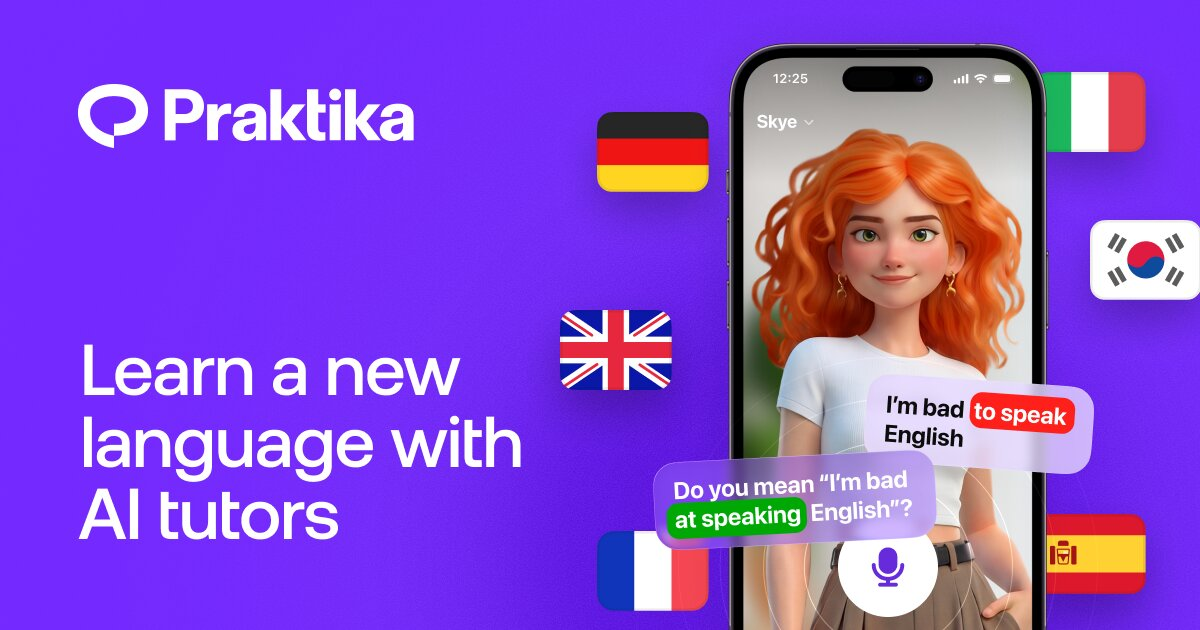
Praktika is the best app to learn Spanish overall for anyone who wants to speak. Every session is a spoken conversation with a human-like tutor, so you can learn Spanish with an AI tutor from your first day, even as a complete beginner.
The tutor corrects your pronunciation, grammar and word choice as you talk, shows a better way to say it and explains the mistake, then carries on with the conversation. It remembers your goals, recurring errors and the words you've learned, so each week builds on the last.
Beginners get explanations in their native language, and the tutor gradually moves to Spanish as they progress. You can rehearse the talks you need, from greeting a customer to small talk in the break room, in sessions that average 12 minutes.
The results show up in what learners say. On average, 73% of active learners gain a full CEFR level in about 20 hours of practice, and more than 30 million people have learned with Praktika.
Best Spanish Learning App: In-Depth Review & Comparison
Below, we review the 10 best Spanish language learning apps one by one, covering who each one suits, its standout features, its strengths and limits, and what users say about it.
The list starts with the best all-round pick, then covers the best apps for learning Spanish in every other style. If you're weighing apps for several languages, our guide to the best language learning apps compares them across the board.
1. Praktika
Overview
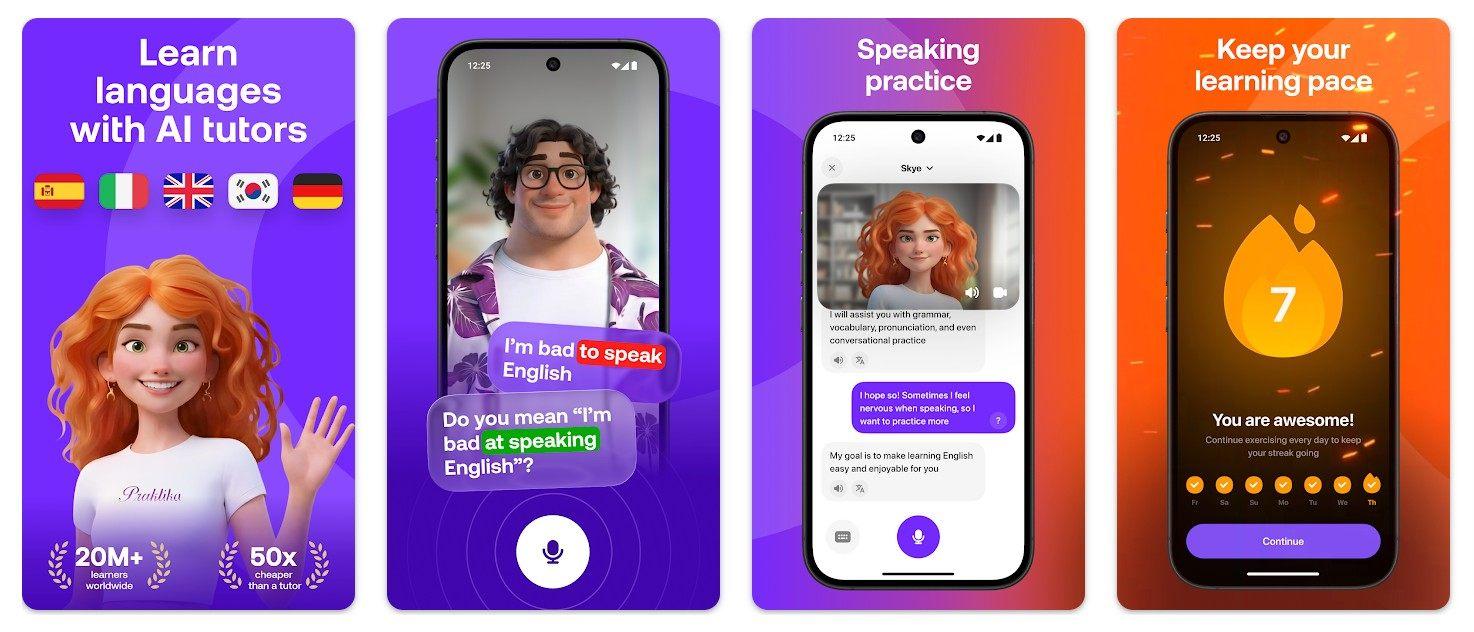
Praktika is an AI tutor app built to get you speaking Spanish out loud with confidence. You hold spoken conversations with human-like AI tutors who listen, respond and correct you in real time. Each tutor has a personality, a backstory and a natural accent, and each one remembers you from one session to the next.
Spanish is one of 14 languages Praktika teaches, and every learner gets a personal study plan built around their goal and level. Beginners start with explanations in their native language, then the tutor brings in more Spanish as they improve.
More than 30 million people have learned with Praktika, with around 2 million active each month in 200+ countries and territories. OpenAI featured Praktika as a case study in January 2026.
Ideal For
Praktika is the strongest pick for learners who want to talk more than they study. It fits these groups best:
- Adults in the US who want to speak with Spanish-speaking customers, coworkers and neighbors without reaching for a phone
- Complete beginners who need explanations in their own language while they start speaking
- Commuters with 10 to 15 minutes on the way to work or during a lunch break
- Travelers preparing for a trip to Mexico, Spain or elsewhere in Latin America
- Former classroom learners who know some Spanish but freeze in conversation
It also suits anyone who feels too shy to practice with real people yet. You can make mistakes in private until the phrases feel natural.
Top Features
Every Praktika feature is designed to give you more time speaking Spanish and better feedback on what you say.
- AI tutors with persistent memory: Tutors remember your goals, mistakes and vocabulary for months, so you stop repeating the same errors.
- Corrections as you speak: Pronunciation, grammar and word choice are corrected in the moment, with a better phrasing and a short explanation, so you fix a mix-up between ser and estar while the sentence is fresh.
- Native-language explanations: The tutor starts in your language and moves toward Spanish as you progress, which keeps beginners from getting lost.
- Practice scenarios and free conversation: Ready-made scenarios, such as ordering at a restaurant, sit beside open conversation on any topic you choose.
- Adjustable feedback, accent and speed: Choose Soft, Balanced or Strict feedback, plus a preferred accent and speaking speed, to match practice to your comfort level.
With Custom Topics, you can also upload a document or script and role-play it with your tutor. That helps if customers ask you the same questions every day.
Why We're the Best App to Learn Spanish
Praktika trains the skill Spanish learners most often say they lack: answering out loud, quickly, in a real exchange. You produce full sentences from your first session, and each one gets feedback on pronunciation, grammar and word choice.
Practice fits real schedules. Sessions average 12 minutes, every session is scored, and your progress maps to CEFR levels, so you can see your Spanish vocabulary getting more advanced week by week.
It's also judgment-free, which matters if speaking Spanish in front of coworkers makes you nervous. On average, 73% of active learners gain a full CEFR level in about 20 hours of practice.
Pros
Praktika's strengths come from putting conversation at the center of every session.
- Spoken Spanish conversations in every session
- Instant feedback on pronunciation, grammar and word choice
- Tutors that remember your goals, errors and vocabulary
- Explanations in your native language for beginners
- Adjustable feedback style, accent and speaking speed
Few apps on this list combine all five in one place.
Cons
No app suits everyone. These are the cases where Praktika may not be your first choice:
- You need an official certificate: Praktika tracks your CEFR level but doesn't issue certificates or prepare you through a certified exam pathway such as DELE.
- You only study on a computer: Praktika runs on iPhone and Android today, with a web app still in testing.
- You want a human teacher on the other side: Marketplaces such as Preply and italki connect you with real teachers.
For learners whose goal is speaking Spanish in daily life, these trade-offs rarely get in the way.
Customer Reviews
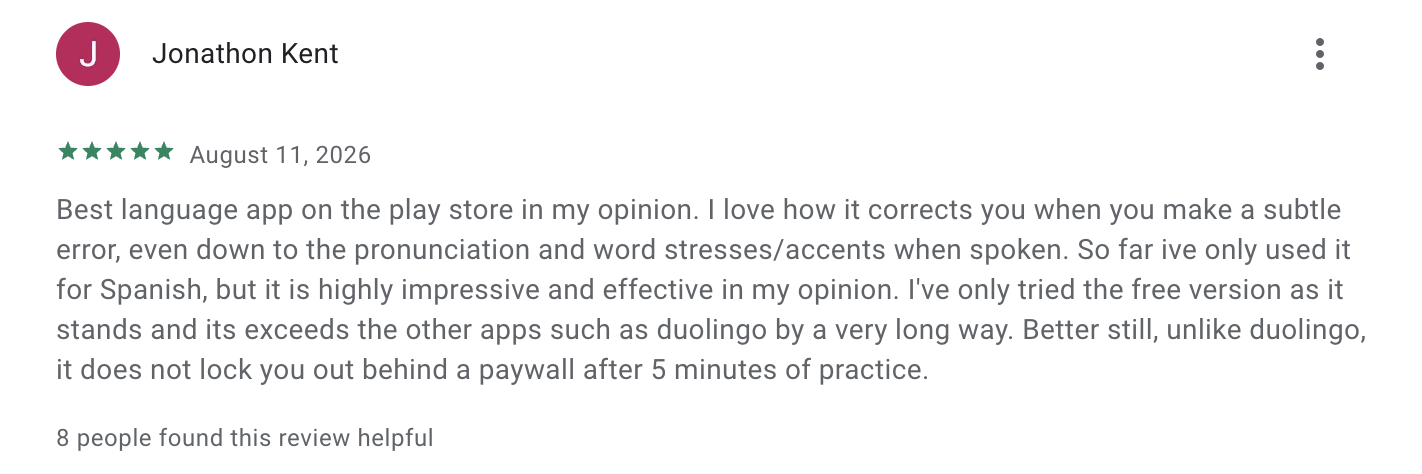
Praktika holds a 4.8-star average across more than 1.2 million ratings on the App Store and Google Play. Reviewers say it got them speaking after years of streak-based apps, and that it makes them answer in complete sentences.
Users praise lifelike tutors and voices, corrections on grammar, pronunciation and word stress in the middle of a real conversation, and practice with no appointments or timetable. One Spanish learner had her native-speaker boyfriend check the app's corrections and feedback, and he was impressed by how good they were.
Final Verdict
Praktika is the best Spanish learning app for anyone who wants to speak Spanish with the people around them. It combines spoken conversation, instant feedback and a tutor that remembers you, in sessions short enough for a commute.
For complete beginners and rusty classroom learners alike, it's the most direct route on this list from knowing words to holding a conversation.
2. Duolingo
Overview
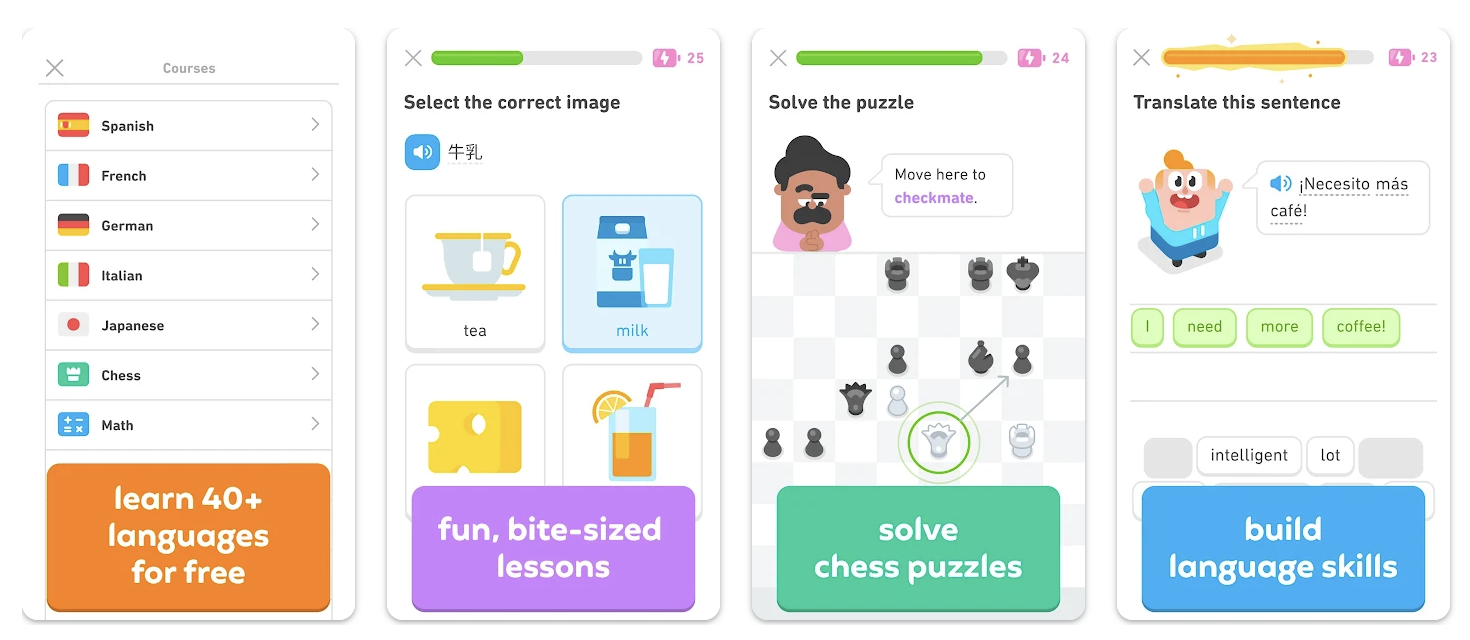
Duolingo is the most downloaded education app in the world and the best-known name in language learning. Founded in Pittsburgh in 2011, it turns study into short lessons with points, streaks and leagues, plus a green owl that nudges you to come back.
Spanish is the first course named in its listing subtitle, and the core course is free. Paid tiers remove ads and add extras, and Duolingo Max includes AI features such as Video Call with its character Lily in select courses.
The app has also expanded into chess, math and music. Its biggest strength is habit-building, since few apps are as good at getting people to open them every day.
Ideal For
Duolingo works best for learners who want an easy, low-pressure start in Spanish.
- Casual learners curious about Spanish before committing to it
- Families who enjoy learning together in a game format
- Budget-conscious learners who want a free starting point
- Habit builders who want a daily routine before moving to deeper practice
It's less suited to people who need to speak Spanish at work within a few months.
Top Features
Duolingo's features are designed around motivation and repetition.
- Bite-sized lessons: Short exercises across reading, listening, writing and speaking keep each session quick.
- Streaks, XP and leagues: Game mechanics reward showing up every day, which keeps the habit alive.
- Stories and practice hub: Short reading and listening activities add context to new vocabulary.
- Duolingo Max: AI features such as Video Call add conversation practice in select courses.
These tools make it easy to keep going on busy days. They work best as a nudge to practice a little every day.
Why It Stands Out
Duolingo is one of the smartest starting points for Spanish beginners who aren't sure how committed they are. Its free core course and game design have introduced hundreds of millions of people to a new language.
Reviewers say the steady flow of new vocabulary keeps them engaged. One credits its daily practice with more confidence speaking conversational Spanish.
Pros
Duolingo's strengths are access and engagement.
- Free core Spanish course
- Habit-forming streaks and rewards
- Short lessons that fit any schedule
- A large catalog of courses and extra subjects
For building a first habit, it's hard to beat.
Cons
Duolingo's weaknesses show up once you try to hold a conversation.
- Exercises train recognition more than spoken answers
- Little explanation of grammar rules
- The energy system limits practice in the free version
- Speech recognition draws frequent complaints
- Reward clutter that some users find distracting
Many learners keep long streaks and still struggle when a Spanish speaker talks to them at normal speed.
Customer Reviews
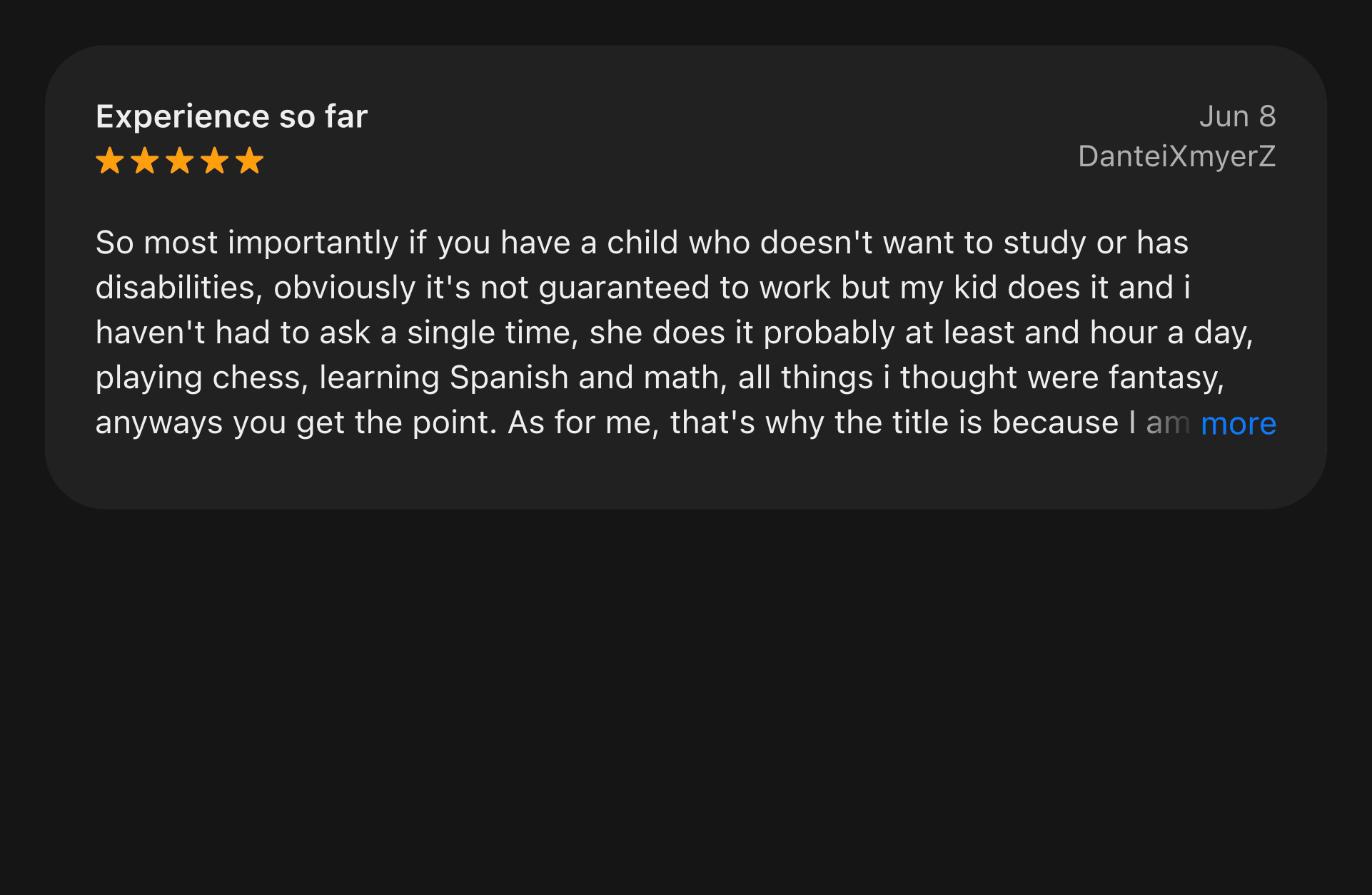
Duolingo holds 4.7 stars on the US App Store (5.5M ratings, Editors' Choice) and 4.8 stars on Google Play (51M reviews, 500M+ downloads). Users praise its game format, the steady addition of new vocabulary and how engaging it is for families.
Recent complaints focus on the energy system that cuts practice short, reward clutter, bugs, thin grammar explanations and surprise charges after free trials.
Final Verdict
Duolingo is a good free starting point for casual learners who want a fun daily Spanish habit. Its game design keeps people coming back like few other apps.
It isn't built to make you a confident speaker, though. Learners who need to talk with Spanish-speaking customers or coworkers will need a speaking-focused app alongside it.
3. Babbel
Overview
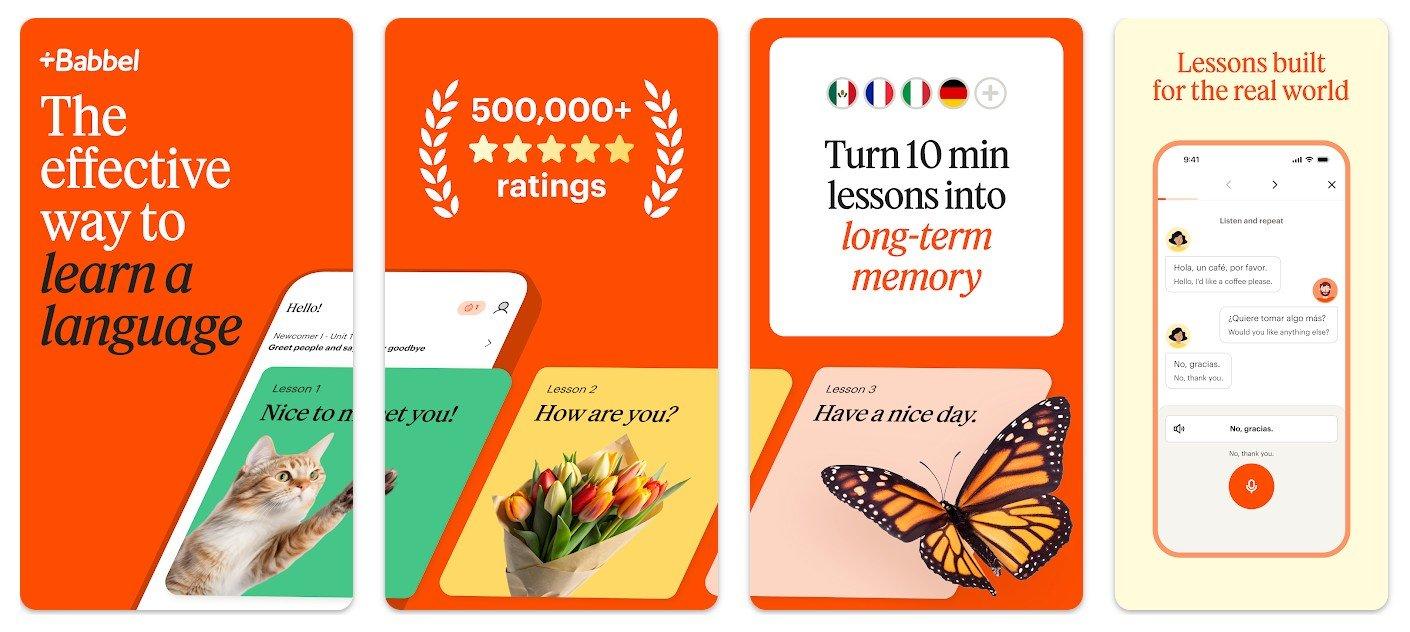
Babbel is a Berlin-based language app that teaches through structured, expert-built courses. Its lessons are created by more than 200 language experts and adapted to your native language, so an English speaker learning Spanish gets different lessons from a French speaker.
Spanish is the headline course in Babbel's listing, one of 14 languages it teaches. Lessons take about 10 to 15 minutes and center on real-life dialogues, with grammar explained along the way, plus podcasts, flashcard-style review and writing lessons.
It has a reputation as the serious adult's language app, with fewer games and more explanation.
Ideal For
Babbel suits Spanish learners who like to know the rules.
- Adults who want clear, structured lessons
- Beginners who want a grammar foundation before they speak more
- Self-paced learners who like choosing their own order
- Travelers who want practical everyday dialogues
It's less suited to learners who want long, open conversations in Spanish.
Top Features
Babbel's features focus on clear, practical lessons.
- Native-language adaptation: Lessons built around the language you already speak target the mistakes you're most likely to make.
- Dialogue-based lessons: Real situations, from shopping to small talk, help you recognize phrases you'll hear.
- Grammar tips: Short explanations inside each lesson make verb endings and sentence order easier to follow.
- Spaced review: Flashcard-style practice brings words back before you forget them.
- Podcasts: Listening practice you can use away from the screen.
Speaking happens mostly through repeat-after-me exercises and dialogue practice. Open conversation plays a small role.
Why It Stands Out
Babbel is one of the strongest choices for learners who want Spanish grammar explained clearly. Reviewers often say it explains more than Duolingo, breaking down pronunciation and showing words in several contexts.
It's flexible as well. You can follow the guided path or study the topics you need in any order, and reviewers like that it skips game mechanics.
Pros
Babbel's strengths are structure and clarity.
- Grammar explained clearly in context
- Lessons adapted to your native language
- Practical, real-life dialogues
- Extra formats such as podcasts and writing lessons
It's one of the most respected course-style apps for Spanish.
Cons
Babbel has weaknesses in speaking practice and depth.
- Limited open conversation in the core course
- Speech recognition sometimes marks correct answers wrong, even for native speakers
- One free lesson before you have to subscribe
- Thinner content at intermediate and advanced levels, according to some reviewers
Some users mention a newer AI dialogue feature, Babbel Speak, that covers only select languages. Check whether your plan includes it for Spanish.
Customer Reviews
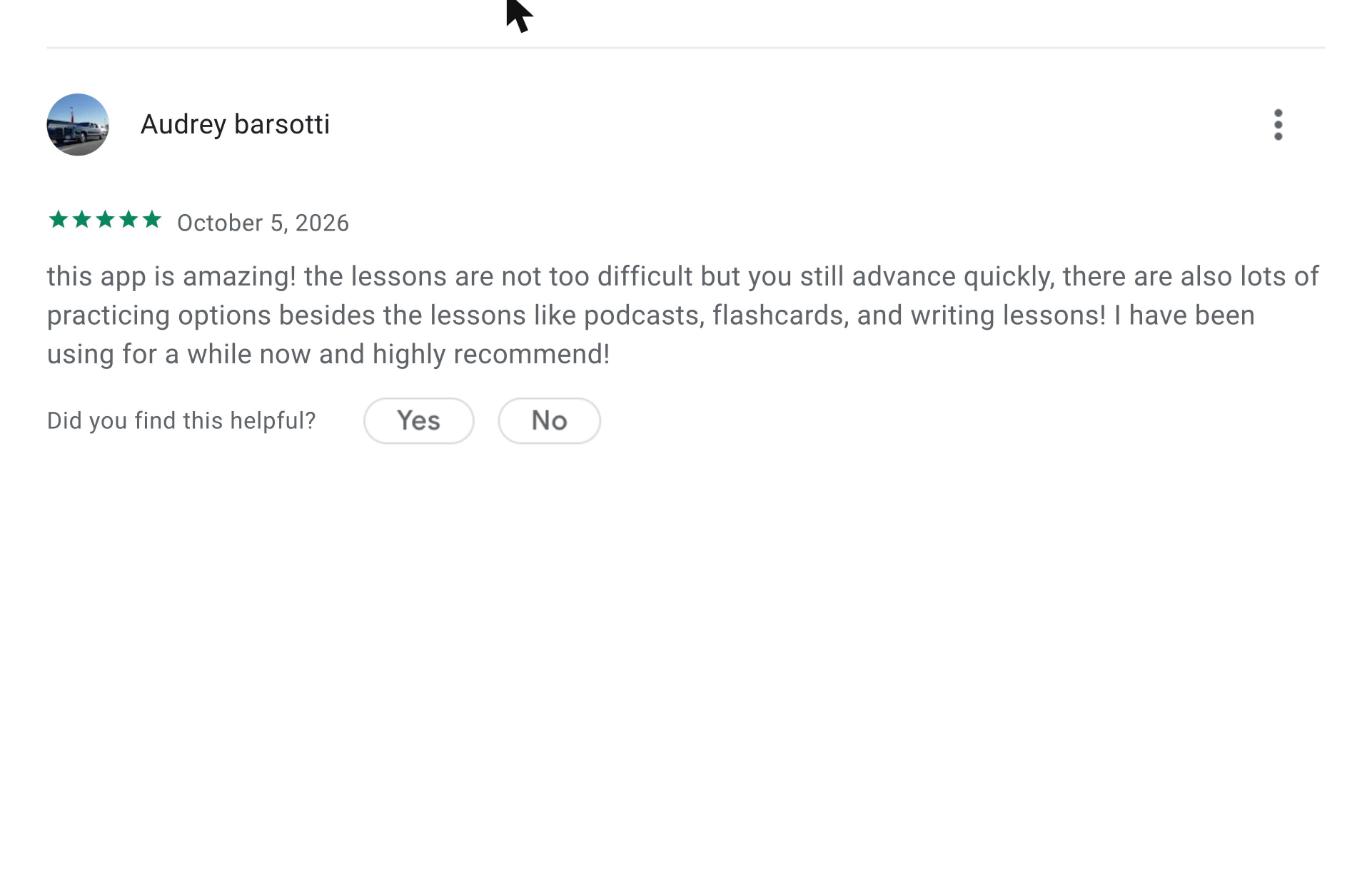
Babbel holds 4.7 stars on the US App Store (756K ratings) and 4.4 stars on Google Play (1.13M reviews, 50M+ downloads). Reviewers value its explanations, the no-games format, the self-paced structure and its podcasts and writing lessons.
The main complaints concern speech recognition, the paywall after the first lesson and weaker content beyond the beginner levels.
Final Verdict
Babbel is an excellent pick for adults who want grammar-first Spanish lessons. It turns short sessions into a clear understanding of how the language works.
Its open speaking practice is limited, and its speech recognition frustrates many users. Learners who mainly want to talk will need a conversation-focused app as well.
4. Speak
Overview
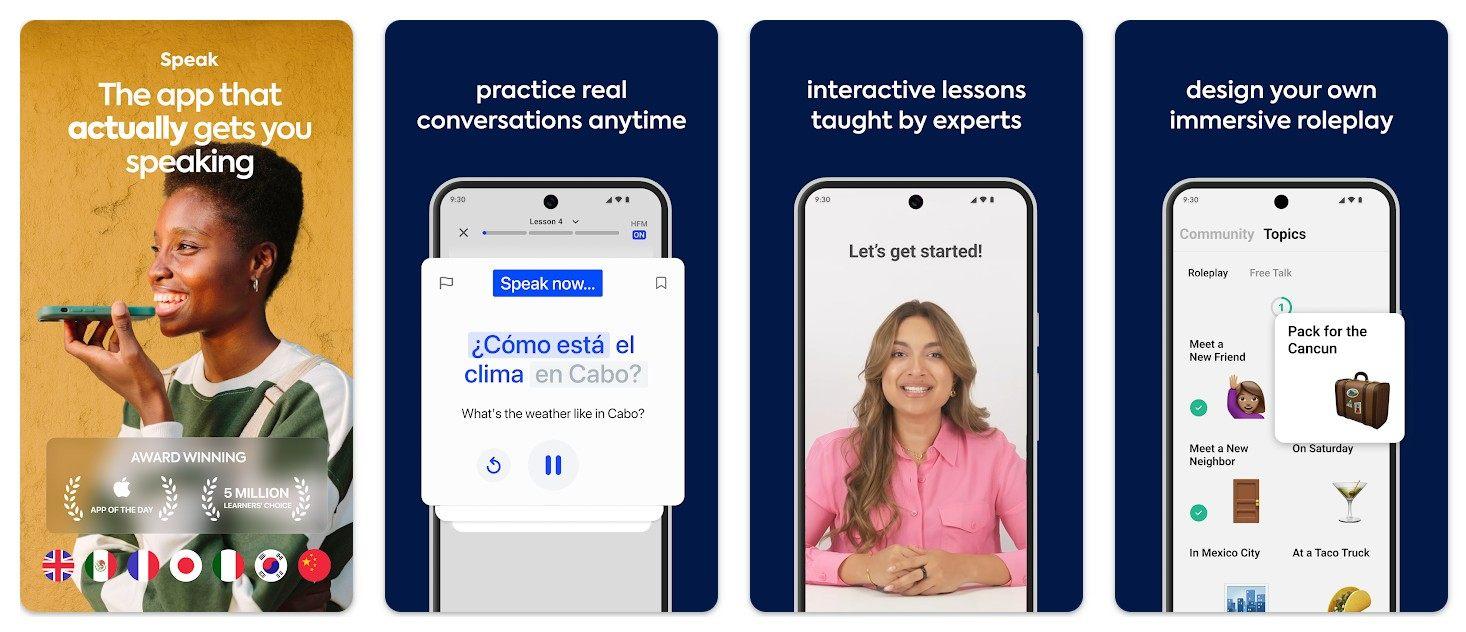
Speak is a speaking-first AI language app from Speakeasy Labs. It was built on the idea that most apps don't get people talking, so its lessons focus on saying full sentences out loud and getting instant feedback.
Spanish is one of its seven languages, alongside English, French, Italian, Japanese, Korean and Chinese. Lessons mix teacher videos, AI speaking drills, roleplays you can design and an AI tutor that answers questions, and the company is backed by the OpenAI Startup Fund.
Recent updates added adaptive lessons built around speaking and audio-first roleplays designed to feel like real conversations.
Ideal For
Speak is a good fit for Spanish learners who want to start talking quickly.
- Speaking-focused learners who like a set course
- Busy learners who prefer five-minute lesson chunks
- Beginners and intermediates who want to build sentence confidence fast
- Learners who only need Spanish or another of its seven languages
If you plan to add other languages later, check its list before committing.
Top Features
Speak's features are built to raise your talk time.
- Speaking lessons: Most of each lesson is spent talking, which builds recall faster than tapping.
- AI roleplays: Custom scenarios let you rehearse realistic conversations in Spanish.
- Instant feedback: Corrections right after each answer fix mistakes on the spot.
- AI tutor: Ask questions about grammar and vocabulary whenever you're stuck.
- Slow-down audio and replays: Slow the voice and redo lessons until phrases stick.
Lessons follow a set course, with roleplays layered on top.
Why It Stands Out
Speak is one of the strongest options for putting speaking first in every lesson. One reviewer says their Spanish improved more in two weeks on Speak than in two months on Duolingo.
Its roleplays bring a sense of real conversation to structured content. Reviewers also describe its listening as accurate and its feedback as detailed.
Pros
Speak's strengths are focus and feedback.
- Speaking practice in every lesson
- Instant feedback on spoken answers
- Custom AI roleplays
- An AI tutor for questions
For Spanish, it packs a lot of talk time into each lesson.
Cons
Speak's limits come from range and consistency.
- Seven languages only
- Speech recognition can be too strict or too lenient
- Only one or two free lessons
- Content can run out at advanced levels
Some reviewers also question its leagues. Others say its ads oversell the app.
Customer Reviews
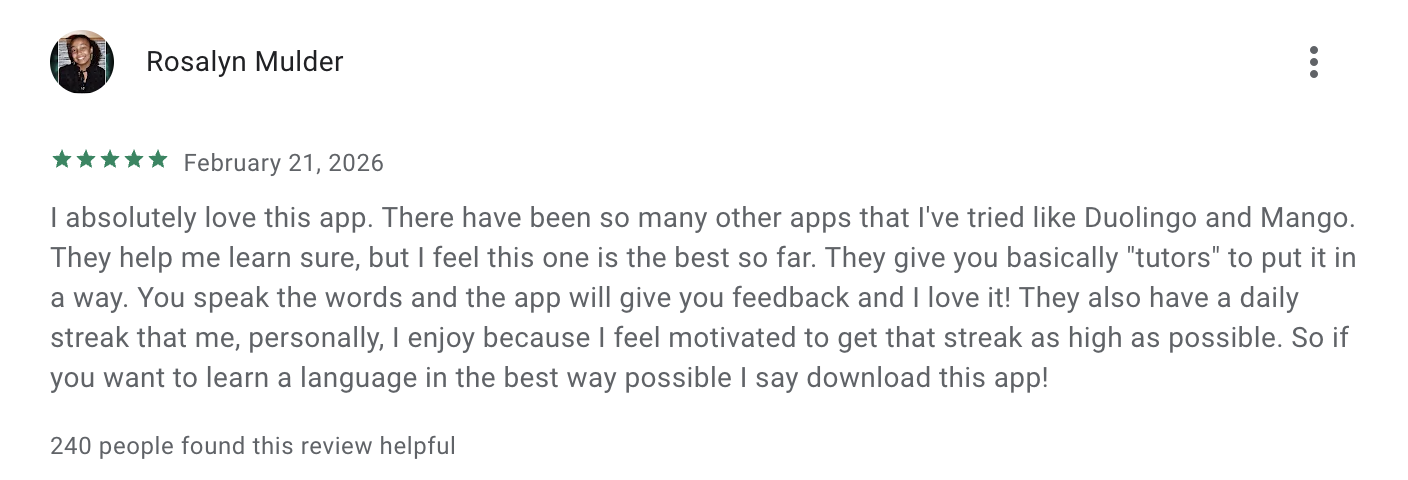
Speak holds 4.8 stars on the US App Store (64K ratings) and 4.7 stars on Google Play (125K reviews, 10M+ downloads). Users highlight its detailed instant feedback, immersive roleplays and how quickly they start building Spanish sentences.
The main complaints are the quick paywall, uneven speech recognition and content running out at advanced levels.
Final Verdict
Speak is a strong choice for Spanish learners who want structured speaking drills in short daily sessions. Its feedback keeps practice active.
Its narrow language list and uneven speech recognition hold it back. Learners who want native-language explanations or a tutor that remembers their mistakes will find a better fit elsewhere.
5. Busuu
Overview
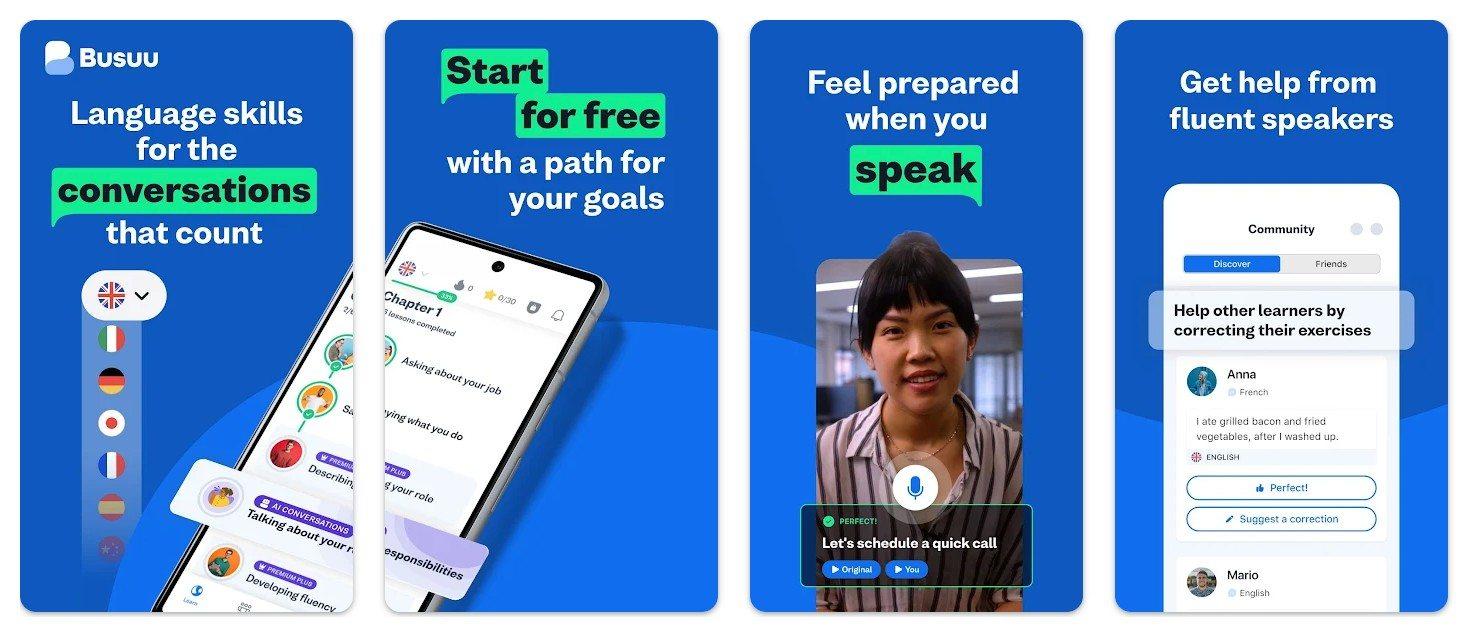
Busuu is a language app that combines expert-designed courses with feedback from a global community of native speakers. You complete exercises, fluent speakers correct your writing and pronunciation, and you help learners of your own language in return.
Spanish is one of its 14 courses, with grammar explanations, cultural notes, videos of real speakers and regular checkpoints. An adaptive study plan sets goals and estimates a completion date, and Busuu is a Chegg service.
On its Premium Plus tier, Busuu also offers AI-powered Conversations in some languages.
Ideal For
Busuu fits Spanish learners who want human input on their progress.
- Learners who want native-speaker corrections without booking a tutor
- Beginners who need structure and clear checkpoints
- Grammar-minded learners who want explanations in context
- Culture-curious learners who enjoy notes on how Spanish speakers talk
It's less suited to learners who want daily open conversation.
Top Features
Busuu's features balance self-study with real feedback.
- Community feedback: Native Spanish speakers review your exercises, so you get human corrections without paying a tutor.
- Grammar and culture: Explanations and cultural tips inside lessons help you sound natural with native speakers.
- Adaptive study plan: Goals, timelines and checkpoints keep you on track.
- Real-speaker videos: Watching how speakers move their mouths helps with pronunciation.
- AI Conversations: Conversation practice on Premium Plus, in select languages.
The community remains its signature feature.
Why It Stands Out
Busuu is one of the smartest choices for bringing real native speakers into a self-study app. Corrections from fluent speakers add a layer of feedback few apps offer.
Reviewers also say its lessons go deeper on grammar and context than Duolingo. They mention more useful phrases for real situations.
Pros
Busuu's strengths come from people and structure.
- Corrections from native speakers
- Grammar explanations and cultural notes
- An adaptive study plan with checkpoints
- Videos showing how native speakers pronounce words
It's one of the better ways to get human feedback inside an app.
Cons
Busuu has some limits, especially in the free version.
- Frequent ads in the free version
- Speech recognition glitches
- AI conversation limited to the top tier and some languages
- Community feedback takes time to arrive
Daily spoken practice isn't where it shines.
Customer Reviews
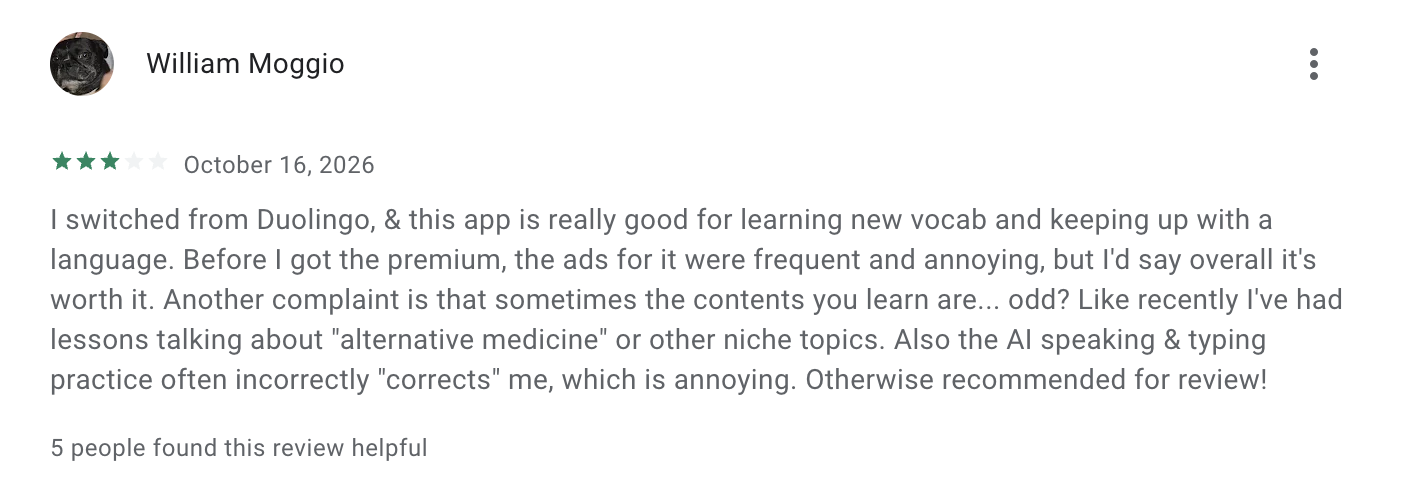
Busuu holds 4.7 stars on the US App Store (101K ratings) and 4.7 stars on Google Play (1.24M reviews, 50M+ downloads). Users praise the community corrections, the grammar detail, the cultural notes and the real-speaker videos.
The most frequent complaints are about ads in the free version, speech recognition problems, limited AI conversation for some languages and pricing tactics.
Final Verdict
Busuu is a smart choice for Spanish learners who want a structured course plus corrections from native speakers. Its grammar and cultural notes help you understand why Spanish works the way it does.
The free version's ads and the limited spoken practice hold it back. Learners who want to speak Spanish with confidence soon will need more conversation than Busuu provides.
6. Rosetta Stone
Overview
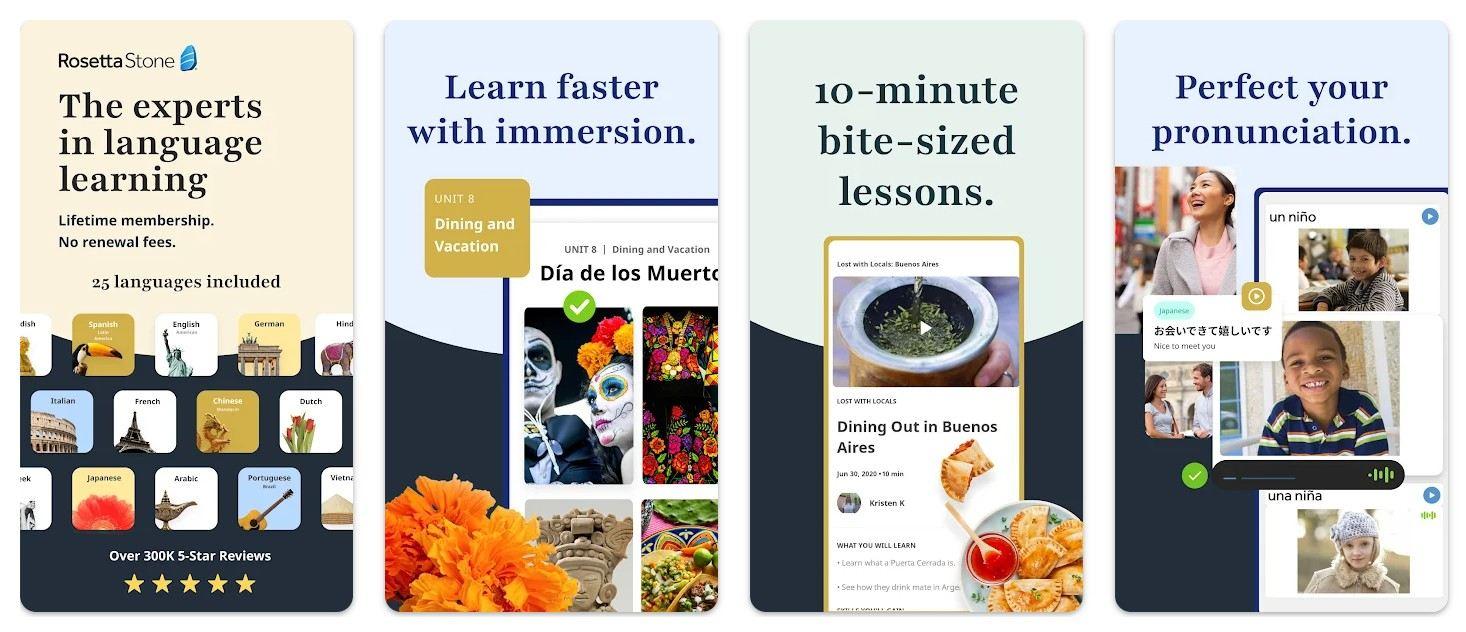
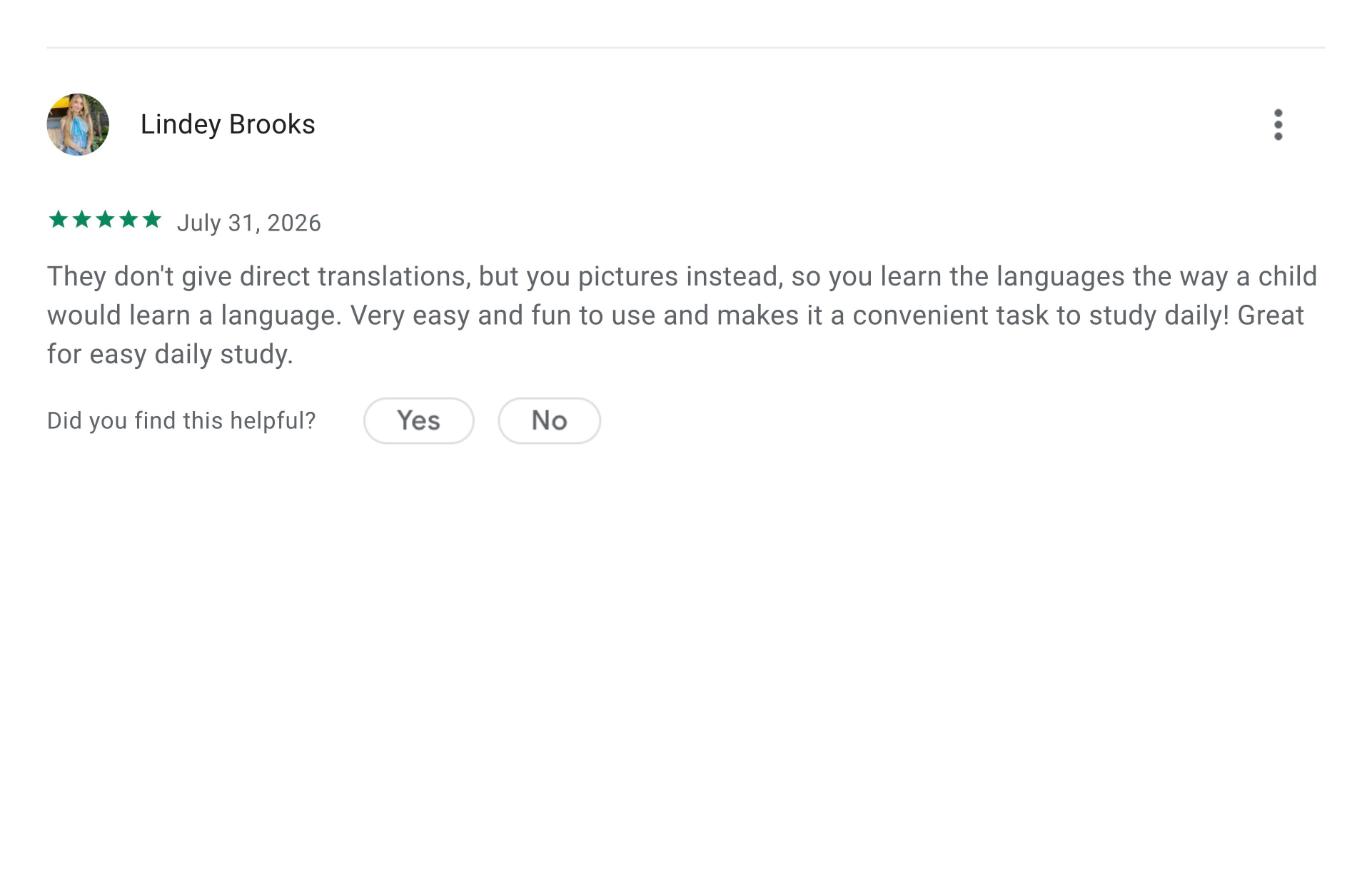
Rosetta Stone pioneered immersion-based language software and has taught languages since 1992. Its method skips translation, so you connect Spanish words and sentences to images, the way children pick up a first language. The company is now part of IXL Learning.
It offers separate courses for Latin American Spanish and Spanish from Spain, among 25 languages, with lessons of about 10 minutes, pronunciation practice and offline downloads. Rosetta Stone Classic now serves existing subscribers, while new learners start with Rosetta Stone Sapphire.
Ideal For
Rosetta Stone suits learners who enjoy learning through context.
- Learners who want a specific variety, such as Latin American Spanish for life in the US
- Visual learners who think in images
- Offline learners who study on planes or in places with a weak signal
- People who dislike game-style apps and want a quiet study space
Learners who need grammar explained step by step may find it frustrating.
Top Features
Rosetta Stone's features revolve around immersion.
- No-translation lessons: Pictures and Spanish only, so you start thinking in the language.
- Regional Spanish courses: Latin American and Spain options let you match the Spanish you'll hear.
- Pronunciation checks: Speech feedback on your spoken answers.
- Offline mode: Download lessons and study anywhere.
- Short lessons: Around 10 minutes each.
The method suits learners who are patient with gradual progress.
Why It Stands Out
Rosetta Stone is one of the strongest choices for learners who want immersion and a distinct Latin American or European Spanish track. Linking words straight to meaning helps many learners stop translating in their heads.
It's also calm and ad-free. Reviewers often describe it as more thorough than game-based apps and a better fit for serious learners.
Pros
Rosetta Stone's strengths come from its method and range.
- Separate Latin American and Spain Spanish courses
- Immersive, translation-free lessons
- Pronunciation practice in every unit
- Offline downloads
It's a focused alternative to game-style apps.
Cons
Rosetta Stone's approach doesn't work for everyone.
- No grammar explanations
- Speech recognition often rejects correct answers
- Early vocabulary isn't always practical for daily conversations
- Confusion during the move from Classic to Sapphire
Learners may understand more Spanish than they can say.
Customer Reviews
The Rosetta Stone Classic app holds 4.8 stars on the US App Store (239K ratings) and 4.8 stars on Google Play (406K reviews, 10M+ downloads). Users praise its immersion method, pronunciation audio, offline mode and calm, ad-free lessons.
The main complaints concern speech recognition, the absence of grammar teaching and access problems for lifetime subscribers moving to the newer app.
Final Verdict
Rosetta Stone is a good fit for patient, visual learners who want immersion and a clear choice between Latin American and European Spanish. It's especially handy offline.
Without grammar explanations or open conversation, many learners plateau. Those who want to speak with customers or coworkers will likely need more active speaking practice.
7. Pimsleur
Overview
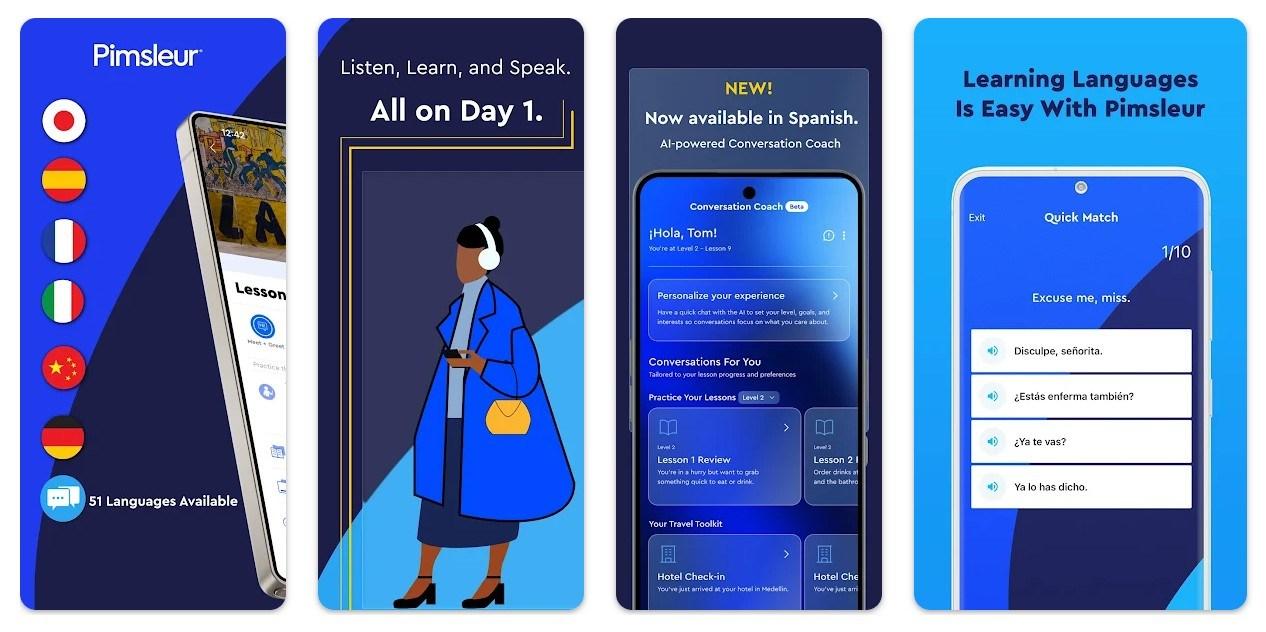
Pimsleur is an audio-based course that teaches you to speak through listening and responding. Each 30-minute lesson asks you to recall phrases and answer out loud, using the method Simon & Schuster has published for around 50 years.
It offers separate Latin American and Castilian Spanish courses among its 51 languages, with flash cards, quick-match games and a Pronunciation Challenge between lessons. Its AI Conversation Coach (Beta), built on your lessons, is available for Latin American Spanish and French learners on the All Access plan.
Its listing pitches lessons on your way to work, during a workout or while doing the dishes. That makes it a natural match for learners who drive.
Ideal For
Pimsleur is ideal for Spanish learners who want to practice hands-free.
- Drivers who want lessons on the way to work
- Auditory learners who remember what they hear
- Learners focused on Latin American Spanish, given the AI coach
- Travelers preparing for spoken interactions
Visual learners may miss written support.
Top Features
Pimsleur's features build on its audio method.
- 30-minute audio lessons: Each builds on the one before, so phrases pile up naturally.
- Spaced recall: Phrases return at set intervals to lock them into memory.
- AI Conversation Coach (Beta): Open speaking practice in Latin American Spanish, built on your lessons.
- Pronunciation Challenge: Focused practice on tricky sounds.
- Flash cards and games: Vocabulary review between lessons.
The audio lessons remain the heart of the course.
Why It Stands Out
Pimsleur is one of the strongest options for fitting Spanish speaking and listening into a drive. You respond out loud in every lesson, without looking at a screen.
Reviewers say it's one of the few apps that focuses on pronunciation and listening. Several say it moved them further than game-based apps did.
Pros
Pimsleur's strengths come from its long-standing method.
- Hands-free audio lessons
- Speaking out loud in every session
- Native-speaker audio
- Latin American and Castilian Spanish courses
Its format suits a car commute especially well.
Cons
Pimsleur's format has trade-offs.
- Fixed pacing, with pauses some users find too short
- Few visuals and limited reading
- Inconsistent voice recognition in the extras
- Less effective at higher levels, according to some reviewers
- Plan structure and subscription management draw complaints
Most conversations are scripted, so open practice depends on the beta AI coach.
Customer Reviews
Pimsleur holds 4.7 stars on the US App Store (30K ratings) and 3.9 stars on Google Play (16.7K reviews, 1M+ downloads). Learners praise its focus on speaking and pronunciation, the hands-free format and its cumulative lessons.
Complaints cover plan costs, rigid pacing, subscription management and weak visual support for some languages.
Final Verdict
Pimsleur is a strong pick for Spanish learners who want to build listening and speaking skills in the car. Its method has a long track record, and its Latin American Spanish AI coach adds open practice.
Scripted lessons and fixed pacing limit flexible conversation. Learners who want personalized feedback on their own sentences will get more from a conversation-first app.
8. Memrise
Overview
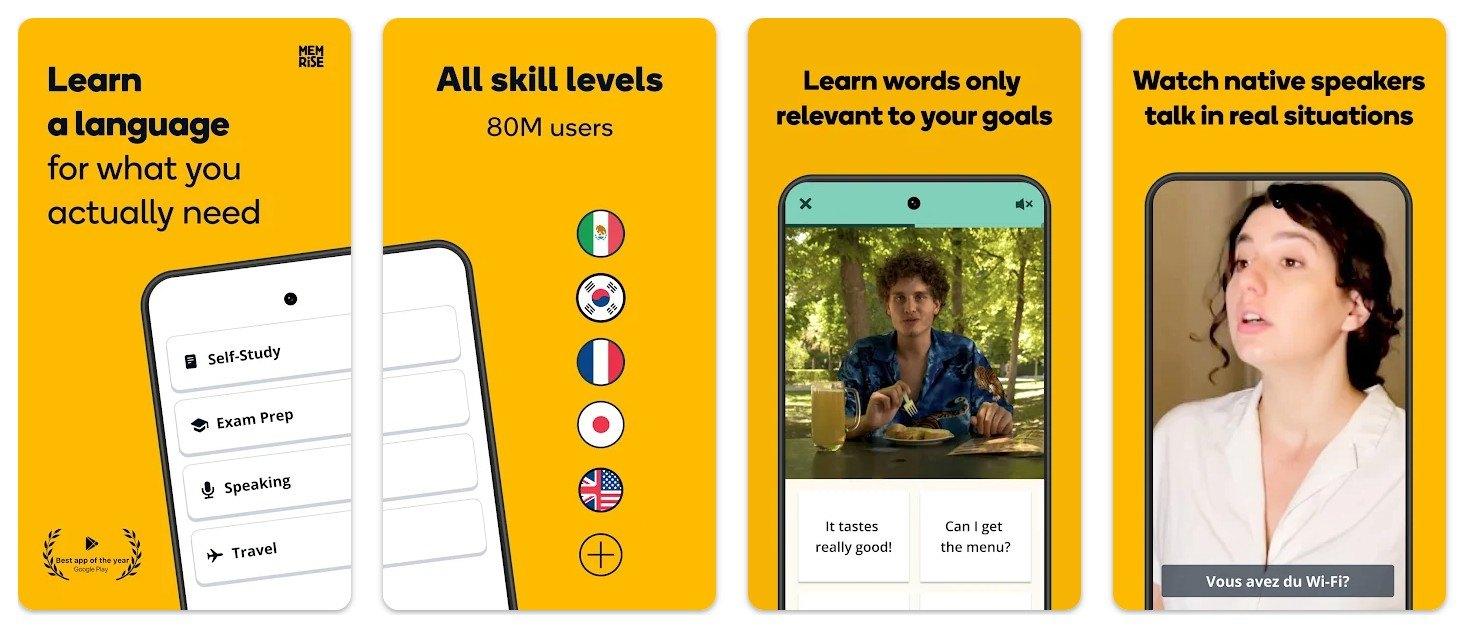
Memrise is a language app built around videos of real native speakers. You watch locals use phrases in everyday situations, which trains your ear for natural Spanish and helps with pronunciation.
You start by choosing a goal, such as travel, speaking at work or exploring a culture, and Memrise focuses on the vocabulary for it. Spanish is one of the first languages named in its listing, and the app adds topic podcasts and daily AI conversation practice.
Memrise says 80 million learners have used it. A recent redesign changed how the app works, and community-made courses now live on a separate website.
Ideal For
Memrise suits learners who want authentic Spanish input.
- Visual and auditory learners who like seeing people speak
- Vocabulary builders focused on useful words
- Travelers preparing for specific situations
- Learners who find game-style apps tiring
It's less ideal for learners who want grammar explained on a free plan.
Top Features
Memrise's features focus on real-world language.
- Native-speaker videos: Real people and accents help you follow Spanish at natural speed.
- Goal tracks: Self-study, speaking and travel paths keep vocabulary relevant.
- AI conversation practice: Daily chats let you use the words you've learned.
- Topic podcasts: Listening practice on subjects you choose.
The native-speaker videos remain its signature.
Why It Stands Out
Memrise is one of the smartest choices for training your ear with real Spanish speakers. Seeing and hearing locals helps vocabulary stick and improves pronunciation.
Reviewers also like that it feels less gamified than many rivals. Its goal-based scenarios keep study purposeful.
Pros
Memrise's strengths are authenticity and focus.
- Videos of real native speakers
- Goal-based learning paths
- AI conversation practice and podcasts
- A generous free tier
For training your ear, it's a strong pick.
Cons
Memrise has frustrated some loyal users recently.
- A redesign removed features long-time users liked
- Community courses moved out of the app
- Grammar explanations require a paid plan
- Reports of bugs and slow support
Advanced learners say progress tends to stall, and some call its AI conversation tool dated.
Customer Reviews
Memrise holds 4.8 stars on the US App Store (217K ratings, Editors' Choice) and 4.6 stars on Google Play (1.57M reviews, 50M+ downloads). Users love the native-speaker videos, the free daily conversation practice and the goal-based scenarios.
Complaints focus on the redesign, the loss of community courses, paywalled grammar and bugs.
Final Verdict
Memrise is a smart pick for learners who want to build Spanish vocabulary and listening skills with real native speakers. Its goal tracks keep study relevant.
The redesign has divided users, and deeper practice needs a paid plan. Learners who want regular spoken conversation with detailed feedback will need a speaking-focused app too.
9. Preply
Overview
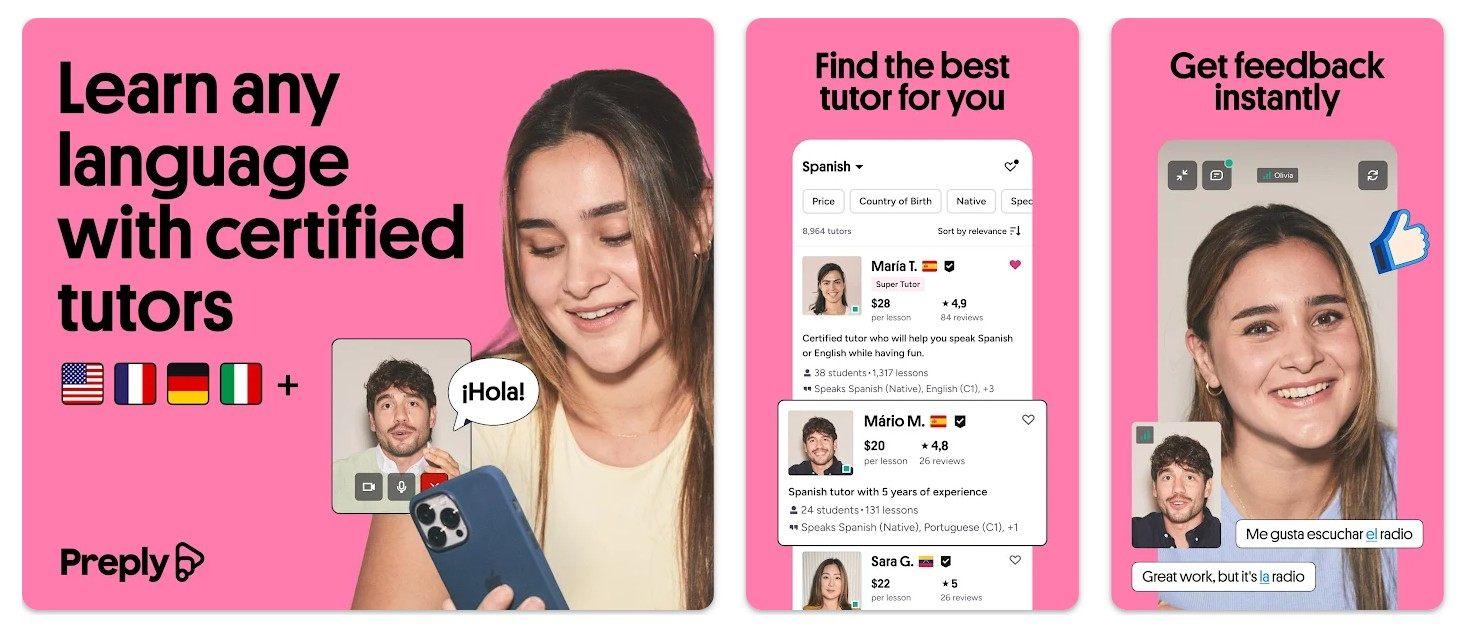
Preply is an online marketplace that connects you with tutors for live, one-to-one video lessons. You set a goal, such as improving your speaking or using a language at work, then pick a tutor by background, accent and schedule.
Preply lists tutors for 90+ languages, and Spanish tutors are plentiful, with teachers from Spain and across Latin America. Lessons run on a subscription with a set number of lessons per 28-day cycle.
Its listing positions Preply against game-style apps and AI tutors alike, with a focus on real conversations with people.
Ideal For
Preply suits Spanish learners who want a human teacher on a regular schedule.
- Learners who want a specific regional accent, chosen through the tutor's background
- Professionals preparing for high-stakes conversations in Spanish
- Learners who need accountability from a person each week
- People with predictable schedules who can commit to weekly lessons
It's less suited to learners who want to practice for ten minutes whenever they get the chance.
Top Features
Preply is built around the tutor relationship.
- 1-on-1 video lessons: Live sessions give you immediate human feedback.
- Wide tutor choice: Spanish tutors from many countries let you hear the accent you need.
- Goal setting: Pick goals such as speaking, work or exams, and lessons follow them.
- Homework and reminders: Tutors keep you accountable between sessions.
Lesson quality depends heavily on which tutor you pick.
Why It Stands Out
Preply is one of the strongest options for personal human feedback in Spanish. A good tutor adapts to your job, your accent goals and your personality.
Reviewers often say a tutor helped them progress further than apps or classrooms did. They also praise the variety of tutors and the scheduling flexibility.
Pros
Preply's strengths come from human teaching.
- Live conversation with a real Spanish tutor
- Tutor choice by country, accent and specialty
- Lessons adapted to your goals
- Accountability through regular sessions
It works well for learners who can commit to a weekly slot.
Cons
Preply shares the limits of any tutoring model.
- Lessons need scheduling, which is hard around shifts
- High cost per hour compared with apps
- Auto-renewal and billing complaints
- Tutor quality varies from one teacher to the next
- Unused lessons can expire at renewal, according to reviewers
Practice also stops between booked sessions unless you add another tool.
Customer Reviews
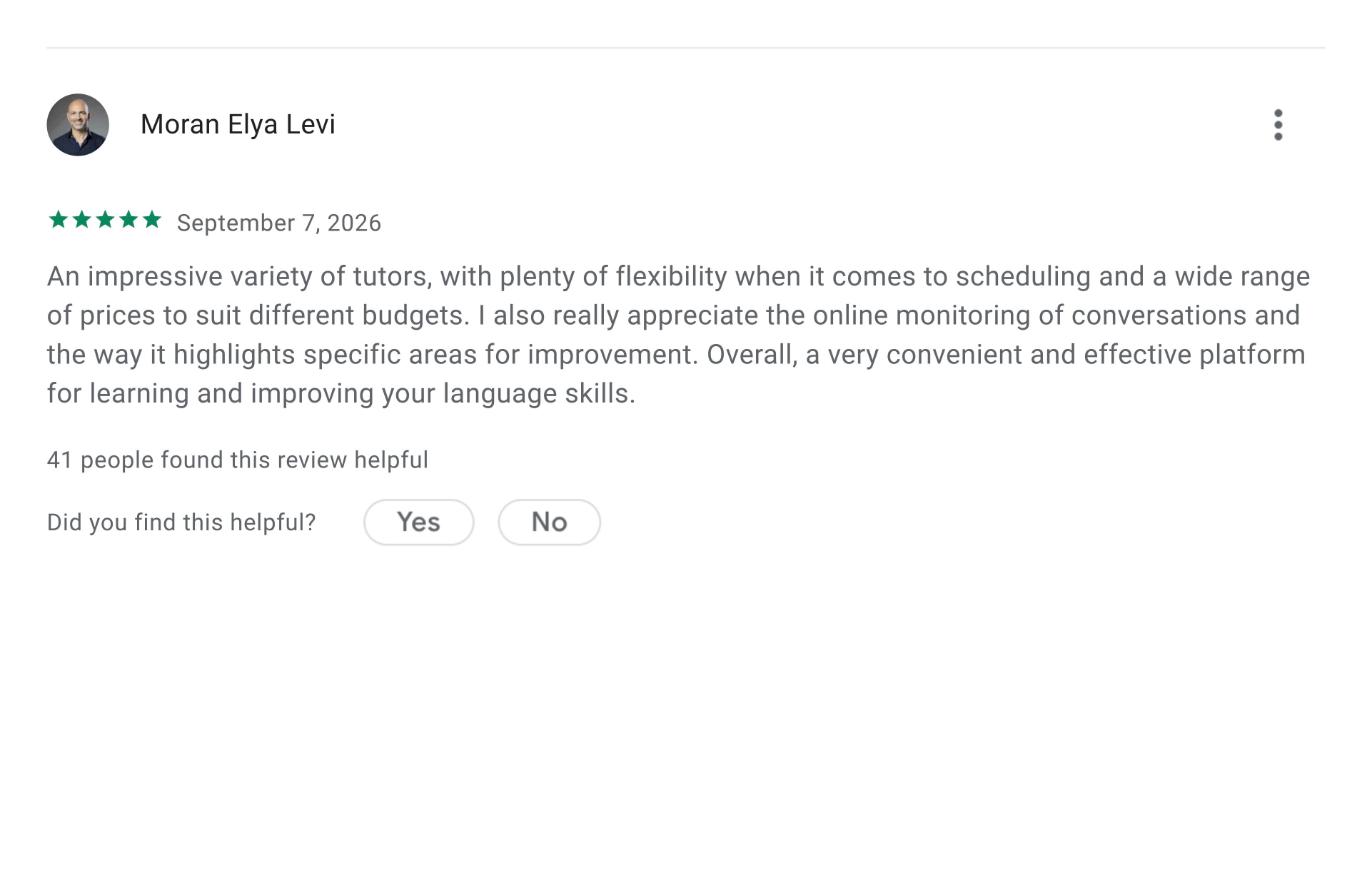
Preply holds 4.8 stars on the US App Store (45K ratings) and 4.8 stars on Google Play (64.8K reviews, 5M+ downloads). Learners praise the variety of tutors, flexible scheduling and progress they didn't get from drill-based apps.
The main complaints involve auto-renewals and billing, unused lessons expiring, tutor price changes after trial lessons and occasional no-shows.
Final Verdict
Preply is one of the strongest options for learners who want a human Spanish tutor and can keep a weekly appointment. It's a good match for high-stakes goals and accent work.
Its cost per hour and scheduling needs make daily speaking practice hard to sustain. Many learners pair occasional tutor sessions with an AI tutor for everyday practice.
10. italki
Overview
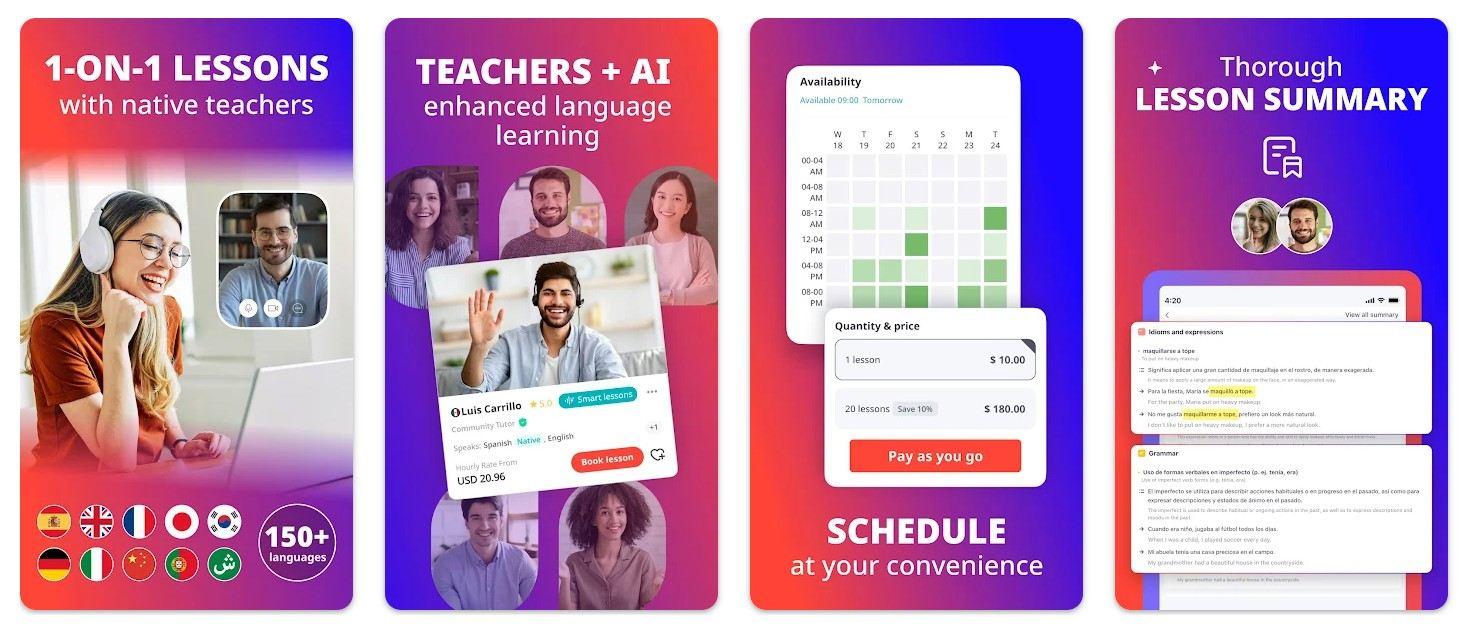
italki is an online marketplace for private lessons with native teachers. You browse teachers, book one-on-one video lessons at times that suit you, and pay per lesson or by package. italki says more than ten million students have learned on it.
It lists 150+ languages, and Spanish is the first language named in its description, with teachers from Spain, Mexico, Colombia, Argentina and other Spanish-speaking countries. Lessons come with summaries of key expressions and grammar, and a free community helps learners find language partners.
Recent versions also add AI-enhanced learning tools alongside its teachers.
Ideal For
italki is a good fit for learners who want personal teaching on their own terms.
- Learners who want a specific regional accent, chosen by the teacher's country
- Introverts who prefer private lessons at home
- Learners who prefer paying per lesson over subscriptions
- Advanced speakers polishing nuance for a particular region
It's less suited to learners who want daily practice on a budget.
Top Features
italki's features revolve around finding and booking teachers.
- 1-on-1 lessons: Private sessions with native teachers give you their full attention.
- Flexible booking: Single lessons or packages, scheduled around your week.
- Lesson summaries: Notes on idioms, grammar and sentence structures help you review.
- Teacher choice: Switch teachers whenever you like.
- Language community: A free space to find practice partners.
The marketplace model gives you control over who teaches you.
Why It Stands Out
italki is one of the strongest options for finding a native Spanish teacher from almost any country. Few marketplaces offer this much choice of region and teaching style.
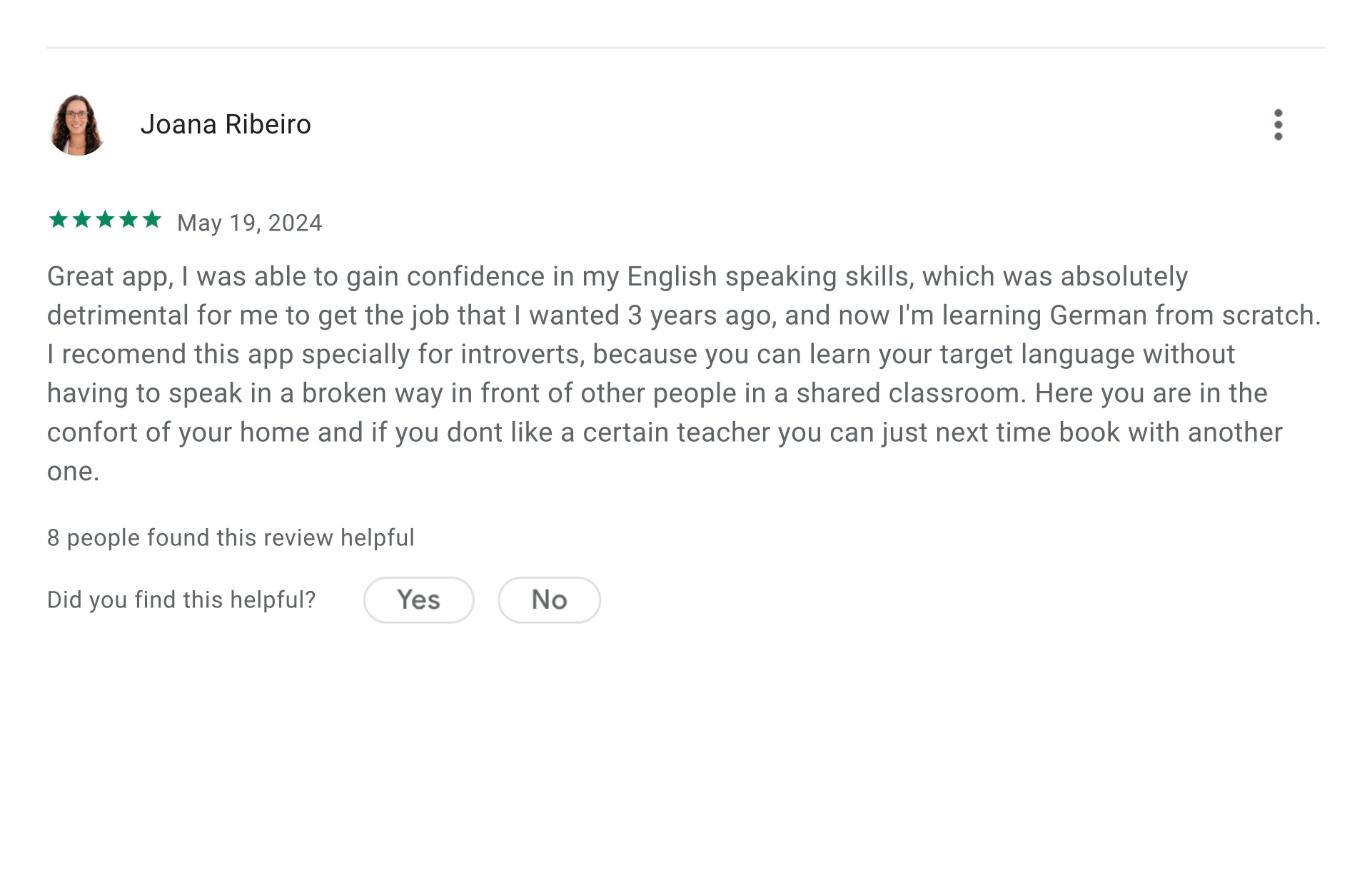
Reviewers credit it with real career results, such as the speaking confidence to land a job. Some recommend it for introverts who prefer learning from home.
Pros
italki's strengths come from flexibility and teacher choice.
- Native teachers from many Spanish-speaking countries
- Freedom to switch teachers at any time
- Pay-as-you-go booking with no long commitment
- Lesson summaries for review
Motivated learners who know what they want get a lot out of it.
Cons
italki shares the limits of tutor marketplaces.
- High cost per hour compared with apps
- Lessons need scheduling
- Teacher quality varies widely
- The app lags behind the teaching, according to some users
Daily practice gets expensive quickly.
Customer Reviews
italki holds 4.8 stars on the US App Store (9.9K ratings) and 4.4 stars on Google Play (18.7K reviews, 5M+ downloads). Learners praise the native teachers, private lessons from home and the freedom to change teachers.
Complaints focus on the app itself, especially tutor search filters such as time zone and finding saved tutors.
Final Verdict
italki is a strong choice for learners who want a native Spanish teacher from a specific country, without a subscription. Its flexibility is a real advantage.
The cost per hour and scheduling make daily speaking practice hard to sustain. Many learners pair an AI tutor for daily practice with an occasional italki lesson.
What Makes a Good App to Learn Spanish?
A good app to learn Spanish prepares you for the conversations you'll have, at the speed people talk. Five criteria separate the apps that build speaking skills from the ones that mostly build streaks.
Every one of the best language learning apps Spanish beginners download promises results. Use these points to test any of them during your first week.
1. Real Speaking Practice From the First Session
Speaking is the skill most Spanish learners want and the one many apps train least. The best Spanish apps for learning to talk get you saying full sentences out loud, well beyond single words.
Check how much of a typical session you spend talking. If it's a small slice, the app will build recognition faster than conversation.
2. Corrections While You Talk
An app should tell you what you got wrong and how to fix it, with corrections on pronunciation, grammar and word choice. For Spanish, that includes noun genders, verb endings and the rolled r.
The most useful feedback arrives in the moment and keeps the conversation going. You fix the error while the sentence is still in your head, then move on.
3. A Personal Plan With Memory
Your goal shapes what you need to practice. Someone talking with customers at a hardware store in San Antonio needs different Spanish from a traveler ordering tapas in Seville.
Look for an app that asks about your goal and level at setup, then adapts as you improve. A tutor that remembers your past mistakes is a strong sign that the plan is personal.
4. Explanations in Your Native Language
Apps that only speak Spanish can overwhelm beginners in the first weeks. Explanations in English, or whichever language you speak best, make early lessons far less frustrating.
The best approach starts in your language and switches gradually. You keep speaking from day one without getting lost.
5. Accent Settings and Progress You Can Measure
Spanish sounds different in Monterrey and Madrid, so control over accent and speaking speed matters. Slower speech helps at first, and a familiar accent prepares you for the people you'll talk to.
Streaks measure consistency. To see ability, look for an app that scores your sessions and tracks your level on the CEFR scale, from A1 to C2.
How to Choose the Best Spanish Learning App
The best app for learning Spanish depends on your goal, your schedule and the Spanish spoken around you. Check these six factors in order to narrow the list fast.
| Factor | What to Check | Why It Matters |
|---|---|---|
| Your conversations | List the situations you face: greeting customers, small talk with coworkers, phone calls, a trip or family visits. | Clear scenarios show which features matter, and speaking goals need conversation practice above everything else. |
| Your Spanish variety | Check which variety each app teaches. In Praktika, you pick a preferred accent and speaking speed at setup, so confirm it matches the Spanish around you. | Latin American and European Spanish share grammar but differ in accent, some vocabulary and forms of address. In Texas, most of what you'll hear is Mexican Spanish. |
| Speaking time | Run a full session and count the minutes you spend talking out loud. | Answering out loud, quickly, is the skill a real conversation tests. |
| Feedback quality | Say a sentence with a deliberate mistake and see whether the app catches it and explains why. | Reviewers report speech recognition that's too strict or too lenient in several apps, so test it before you pay. |
| Daily fit | Match the format to your time: a 10 to 15 minute session on a break, hands-free audio in the car, or a weekly booked lesson. | Many short sessions beat a few long ones, so the app you open most days will move you furthest. |
| Beginner support | Check whether explanations come in your native language and whether you can start from zero. | Spanish-only instruction can overwhelm true beginners and make them quit early. |
Try two or three apps for a few days each before you commit to a long plan. The best Spanish language learning program for you is the one you'll still open after the first month.
Everything You Need to Know About Spanish Learning Apps
This table sums up the guide in one place. If you're still asking what is the best app to learn Spanish for your situation, start here.
| Category | Key Considerations |
|---|---|
| Top 3 Apps | Praktika for speaking confidence with an AI tutor, Duolingo for a free daily habit, and Babbel for structured grammar. |
| Best Overall Option | Praktika, the best app to learn Spanish language skills for conversation, with instant corrections, memory and native-language explanations. |
| Why Use a Spanish App | Apps fit practice into short daily sessions, so you can practice on a commute and use new phrases with customers, coworkers and neighbors the same week. |
| How to Choose | Match the app to your conversations, the Spanish spoken around you and your daily schedule, then time a real session. |
| Ease of Getting Started | Easy. Most apps place you by level in a few minutes, and the best language app to learn Spanish from zero explains in your native language. |
| Must-Have Features | Speaking practice, real-time feedback on pronunciation and grammar, a personal study plan, accent and speed settings, and measurable progress. |
| Mistakes You Shouldn't Make | Choosing by brand alone, chasing streaks over speaking time, ignoring which Spanish variety an app teaches, and paying for a year before testing. |
Searching for the best learn Spanish app can feel endless, but the shortlist above covers most learners. Spanish also gives you a head start on related languages, so when you're ready for the next one, see our guides to the best app to learn Italian, the best app to learn Portuguese and the best app to learn French.
If your whole team needs Spanish for work, our guide to the best corporate Spanish training compares the options. Praktika for Business also offers a free one-month trial for up to three people.