
Corporate Japanese Training
Get your whole team speaking Japanese at work
Employees practice keigo, client calls and meetings in Japanese with an AI tutor. HR sees every learner's CEFR level in one dashboard.30M+ learners

明日、御社に行きます
「明日、御社に伺います」ということですか?
Trusted by





Corporate Japanese training with measurable progress

Ready for Japanese partners sooner
Prepare new hires for first calls with clients in Tokyo and OsakaCEFR progress per learner
Track weekly practice and level changes for each Japanese learner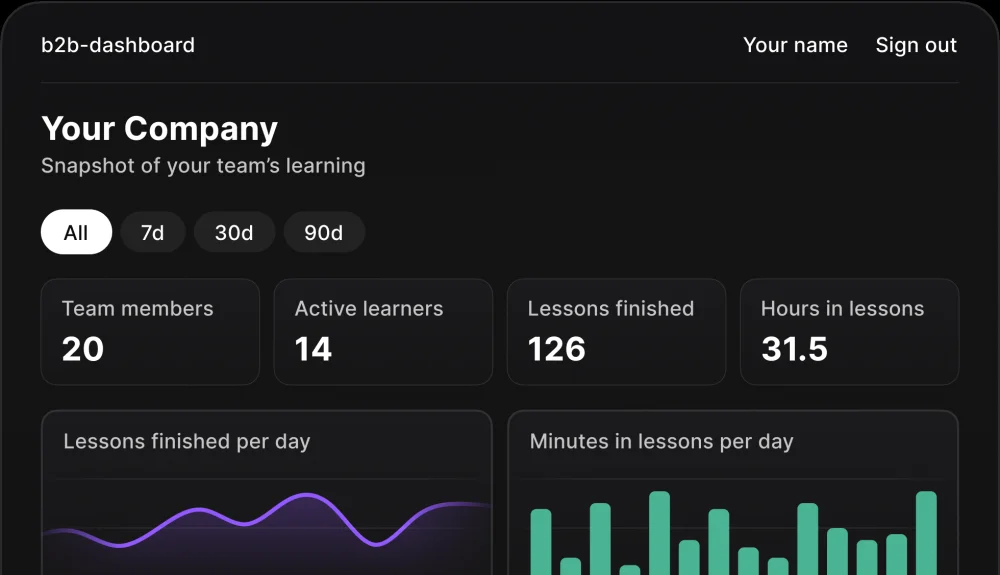

30M+learners

 4.81.2M+ ratings
$30M+raised
Japanese for business, keigo included
Practice introductions, supplier calls, meetings and formal emailsPresentations
Discovery call
Interview
Written communication
Client call
Customer support
Status update
Stand-ups
Negotiation
Sales pitch
Japanese plus 13 more languages on one license
Chinese
Spanish
English
German
Italian
Japanese
French
Korean
Polish
Russian
Portuguese
Arabic
Dutch
Pricing
Choose your corporate Japanese training plan
Starter10–49
$12/ user / month
- Full language catalogue
- Speaking, listening, reading & grammar exercises
- Pronunciation score
- Monitoring dashboard
- Instant checkout via Stripe
Security
- Encryption at rest and workspace isolation
- No stored passwords (one-time codes or OAuth)
- Real deletion of your data, on request
Support
- Help center and email support
Growth50–99
$10/ user / month
- Full language catalogue
- Speaking, listening, reading & grammar exercises
- Pronunciation score
- Monitoring dashboard
- Instant checkout via Stripe
Security
- Encryption at rest and workspace isolation
- No stored passwords (one-time codes or OAuth)
- Real deletion of your data, on request
Support
- Help center and email support
- Priority support
Popular
Scale100–199
$8/ user / month
- Full language catalogue
- Speaking, listening, reading & grammar exercises
- Pronunciation score
- Monitoring dashboard
- Instant checkout via Stripe
- Dedicated onboarding
- Multiple payment methods on request
Security
- Encryption at rest and workspace isolation
- No stored passwords (one-time codes or OAuth)
- Real deletion of your data, on request
- SSO and audit logs
Support
- Help center and email support
- Priority support
- Onboarding call and setup help
Enterprise200+
Custom
- Full language catalogue
- Speaking, listening, reading & grammar exercises
- Pronunciation score
- Monitoring dashboard
- Instant checkout via Stripe
- Dedicated onboarding
- Multiple payment methods
Security
- Encryption at rest and workspace isolation
- No stored passwords (one-time codes or OAuth)
- Real deletion of your data, on request
- SSO and audit logs
- Custom contract, DPA and invoicing
Support
- Help center and email support
- Priority support
- Onboarding call and setup help
- Dedicated account manager
Use cases
Japanese at work, case by case
Work with Japanese suppliers
Report to Tokyo headquarters
Win Japanese clients
Host visiting delegations


For HR & L&D leaders
Business Japanese, scored on spoken answers
Daily practice on mobile
Levels from real speech
From first phrases to keigo
Invites by work email
Business Japanese
questions, answered
For HR, L&D and teams working with JapanWhy choose Praktika for corporate Japanese training?
Each employee practices the Japanese their role needs, including the polite forms clients and partners expect, with an AI tutor that corrects them as they speak. Japanese tutors at $50 to $120 an hour rarely reach beyond a few people. Praktika comes to about $3 per hour of practice, and HR follows every CEFR level in one dashboard.
How fast does business Japanese improve with Praktika?
The US Foreign Service Institute counts Japanese among the hardest languages for English speakers, at about 88 weeks of full-time study for professional working proficiency. Praktika's cohort data shows 73% of active learners gaining a full CEFR level in about 20 hours of practice, on average. Expect individual pace to vary.
Which work situations can employees practice in Japanese?
Self-introductions, supplier calls, client meetings, presentations, negotiations and formal emails, along with other scenarios. Teams can upload a product sheet or meeting agenda as a Custom Topic and rehearse it in Japanese. That makes Praktika a business Japanese course built on your own material.
Does it work for employees at different Japanese levels?
Yes. Learners pick a level from A1 to C2 when they set up and get a plan for it. Complete beginners receive explanations in their native language as they build basic phrases, and advanced speakers practice keigo for client meetings.
How many licenses do we need to start?
The starting point is ten licenses. The price per seat drops at 50 and again at 100 seats, and seats move between employees at no cost. Up to three people can trial Praktika for a month, without a credit card.
Can teams do corporate Japanese training online?
Yes. The app runs on iPhone and Android, so employees can practice Japanese before a call with Tokyo or on the way to a meeting. HR manages licenses and progress in a desktop dashboard.
Can employees learn other languages on the same license?
Yes. All 14 languages are part of every license, so a team that works with Japan and Korea needs one contract. Employees can switch languages whenever they want, at no extra cost.
What can HR and L&D teams see?
The dashboard shows active learners, invitations not yet opened, lessons completed, practice minutes and each person's CEFR level and history. Praktika can also export usage data on request for internal reports.
Is employee data used to train AI models?
No. Learner recordings and transcripts are never used to train Praktika's models or any supplier's models. Praktika complies with GDPR, CCPA and FERPA, encrypts data in transit and at rest, and provides security documentation on request.
Does Praktika integrate with our LMS or HR system?
Not at present. Praktika has no LMS, HR-system or Microsoft Teams integration, and employees sign in with a work email. Seats and usage are managed in the admin dashboard, so rollout needs no IT project.


Ready to plan corporate Japanese training?
Start with ten licenses before your next meeting with partners in Japan.Contact us for more informationFill out the form, and our enterprise team will contact you with a customized solution